Laptop

“Uncovering” Online Reviews, Paradise Leaked, and Activists: Checking In

Here’s What You Need To Know

90% of consumers read online reviews before visiting a business and 67% of consumers are influenced by what they read in those online reviews. But while the majority of people who use these reviews believe they generally give an accurate picture of the product or service, many also agree that it is challenging to tell whether such reviews are truthful or biased.

One reporter’s benign quest for a new mattress resulted in “uncovering” the secret world of online mattress reviews, and even more broadly, illustrated the high-stakes, hard-fought battle for the control of influential and lucrative platforms for influencing what Americans think about various products, services, and more. Because consumers trust review sites, companies – like those in the online mattress industry – have been waging a behind the scenes campaign to influence the reviews of supposedly independent sites, or at least those perceived to be independent by consumers.

So how can you know that the websites you visit, and reviews you read, are legitimate? At Delve, we know how to uncover hidden motives, so just in time for the holiday shopping season, here is our advice for “uncovering” the world of online reviews, so that you can better evaluate the online information you use to make better buying decisions:

  1. Who Is Behind Online Reviews? The reality of online reviews is messy. They can be placed by a hired marketing consultant, a friend of a business, another business as part of a “review-swapping” agreement to leave a fake positive review or a fake review to disparage a competitor, or even a “professional product reviewer” who receives commissions to post reviews on sites like Amazon.com. Thankfully, there are now websites, such as fakespot.com, that verify online reviews by looking for words or phrases commonly used in fake reviews, and whether the reviewer has submitted an unusually high number of positive reviews – which can indicate some sort of financial incentive. Some of these sites also are transparent about receiving compensation, if you scan the fine print of their “About Us” web page.
  2. What Are The Other Financial Implications To Consider? Financial motivations drive the challenges posed by fake online reviews, and there are several ways to monetize this lucrative niche. Review websites may have an affiliate marketing arrangement with vendors, giving the website owner a commission or rebate for every purchase made by a consumer who bought the product or service reviewed. Such arrangements were crucial in helping the online mattress industry quickly grow into a $1.5 billion business. Wirecutter, the popular product review site that was purchased by The New York Times, has used this model to generate between $10 million and $20 million of revenue last year.
  3. What Legal Tactics Are Used To Influence Review Sites? When companies can’t buy off reviewers, some have turned to lawsuits to stifle popular review websites that did not rate their products or services higher than those of competitors. This was the case with various online mattress review websites, eventually leading to the takeover of some of these sites by online mattress companies. Similar to financial arrangements, disclaimers illuminating any conflicts of interest are worth searching out on each site.
  4. Isn’t Government Supposed To Stop Such Practices? There has been some action by regulators. The Federal Trade Commission (FTC) has already settled with a car dealership for deceptive and unfair sales tactics, including fake reviews it planted online. But when it comes to the online mattress industry, where marketing affiliations and incentives may be unclear to consumers, one CEO said, “Honestly, the FTC has to step in at some point and make review sites divulge what they are paid for each bed or brand…This industry is a freight train out of control.” Therefore, using tools and tactics to better evaluating online reviews is the surest way for people to protect their interests.

While businesses are hiring reputation-management firms to help undo damage done by critical reviews and taking a number of other steps, consumers need to understand the motivations and incentives driving the various stakeholders in the lucrative world of online reviews. Use the above analysis as a guide for evaluating online reviews this holiday season, and you will be an educated consumer who can discern an information advantage from the online reviews you see – negative, positive, and everything in between. Happy holiday shopping!

News You Can Use

PRESSURE FOR TAX REFORM…FROM EUROPE?

 Republicans in Congress are continuing their push to get a tax reform bill to the President’s desk by the end of the year, and they may be getting pressure to make good on this campaign promise from an unexpected place: Europe. The Netherlands and France are both working on tax reform plans that focus on simplicity and lower rates, which is notable given Europe’s high tax burden.

Recent momentum on Capitol Hill suggests Republicans know that their political future depends on being able to make tax reform law. While that may be pressure-enough, should these two European countries implement their tax reform plans – which may help entice businesses looking to leave Britain after Brexit – other businesses and investors around the world may look there for opportunities too, rather than to the world’s biggest economy in the U.S.

PARADISE LEAKED

Who leaked the Paradise Papers? Despite the coverage of the 13.4 million financial documents related to how politicians, celebrities, and high-net-worth individuals use offshore accounts to protect their money from higher taxes, little attention is paid to how this information was obtained and who was behind it. This begs the question, writes Holman Jenkins Jr. of The Wall Street Journal Editorial Board, as to whether the International Consortium of Investigative Journalists may unwittingly be doing the bidding of an intelligence agency.

Just as Wikileaks is viewed as a likely front for Russian intelligence, could that – or a different – intelligence agency have hacked these documents and provided them to ICIJ to embarrass a particular target, or achieve a particular objective? Given the heightened scrutiny surrounding the source and motivations of cyberattacks, Jenkins’ suggestion that only after uncovering who hacked these documents and their motivations can we then make “more intelligent inferences” about the Paradise Papers’ significance may be the most important aspect of the entire investigation.

THE KREMLIN’S NOT-SO-SUCCESSFUL FACEBOOK CAMPAIGN

Longtime political digital media strategist Patrick Ruffini has run digital campaigns in numerous U.S. states as well as other countries, and when it comes to the Kremlin’s Facebook influence campaign, he’s not impressed. Rather than a “catastrophic success,” Ruffini uses his past experience to argue that the Kremlin’s Facebook campaign was less-successful than portrayed. The Kremlin spent $100,000 in advertising on Facebook, reaching as many as 126 million Americans.

Yet, this is a tiny fraction of the 33 trillion posts Americans viewed on the social media platform between 2015 and 2017 – and for context, the Trump and Clinton campaigns spent $81 million to mobilize their respected supporters on the platform. Ruffini cautions against letting the relatively small number of poorly-targeted ads placed by the Kremlin, which were designed to enable extremist voices on the political fringes rather than target persuadable independent voters, push through legislative initiatives that could curtail free speech – a position he shares with a longtime Democratic consultant.

GREEN DOOM AND UNANTICIPATED INNOVATIONS 

Whether it was the prediction that 20th century London “will be buried under 9 feet of manure,” or that the United States’ abandonment of the Paris Climate Agreement is a “disaster,” governments and supposed experts predicting doom and gloom environmental scenarios is a constant. However, due to unanticipated innovations in the free market, we have largely avoided the negative fates often predicted. Twenty-five years after the prediction of a street buried under feet of manure, the combustible engine, and the advent of the affordable, personal automobile made the horse – and the waste that exposed 19th century residents to biohazards and lethal diseases – irrelevant as a transportation source.

Indeed, despite the criticism leveled against its on-again, off-again climate policies, the U.S. has actually reduced carbon emissions more than any other country on earth over the last 16 years, an amount four times greater than the country with the second largest reduction and equal to the reductions of the next eight countries combined. With any new predictions from governments and experts come proposed solutions, but the facts suggest that the free market and a level playing field have been making both a moot point.

ACTIVISTS: CHECKING IN

The Eaton Hotel in Washington, D.C. is opening in 2018 and it will be the first in a chain of hotels to cater to activist and activist-minded travelers. Owned by the same parent company as the Langham Hospitality group, rooms for the 4-star property will go for between $250 and $300 a night. But are there any ideological constraints on who can stay at the Eaton? Not necessarily, although the founder and president believes that the property is for those with generally more “progressive” values, and that the clientele will be “self-selecting.”

To cater to this clientele, the hotel will have featured events and speakers – on topics ranging from climate change to race relations, several activist-artists in residence, a cinema that screens films about social good and human rights, a coworking space, a wellness center dedicated to “new age health,” and other services tailored to this “shared social mission.” In an era of greater ideological divides than ever before, it remains to be seen whether a hotel that segregates by ideology proves as alluring a “shared social mission” as one that appeals to engaged activists on both sides of the ideological spectrum to come together to find consensus.

Curtain

Pulling up the Curtain on the Political Hanger-on, Zero Stars From Yelp, and a “Confirmation Bias Tour”

Here’s What You Need To Know

Last week, it was announced that former Trump presidential campaign foreign policy advisor George Papadopoulos plead guilty to lying to federal agents about his contacts with Russians connected to the Kremlin. After this revelation, the President took to Twitter to refer to Papadopoulos as a “young, low level volunteer named George,” the White House Press Secretary called him a “volunteer” with an “extremely limited” role, and a former campaign advisor said that Papadopoulos was “the coffee boy.”

All of this begs the question as to how the 30-year-old was able to represent the Trump campaign on occasions such as a panel at the 2016 Republican National Convention and in an interview to Russia’s Interfax News Agency, if he was indeed just “the coffee boy.”

The investigations into Russian-meddling in the 2016 election continue, but the Papadopoulos episode – that of a young, relatively-unknown person who was an unpaid advisor on another presidential campaign before joining the Trump campaign – bears some resemblance to that of a classic political hanger-on, who seeks an advantage by associating with a political campaign. With people looking to capitalize on their experience or access gained through campaigns, we want to pull up the curtain on political hangers-on, so that you can better recognize and assess the claims made by individuals, consultants, and firms that approach you:

  • What Makes A Political Hanger-On?  Someone who attaches to a political campaign for personal gain, like currying favor for a future job or appointment, using it as a springboard to elected office, or monetizing “access” to policymakers. Affiliating with a campaign, even as an unpaid volunteer or in helping with fundraising, is a way to burnish one’s resume and credentials. And should the campaign win, it can lead to lucrative new opportunities.
  • Why Do Campaigns Let This Happen? Showing broad support is crucial in a campaign, particularly when trying to show policy depth and expertise. Unpaid policy advisors – particularly on presidential campaigns – are often quite influential, with direct access to the candidate and may help craft policy platforms, speeches, and talking points. However, given the large number of candidates in the Republican primary, and Trump’s nontraditional background, he was unable to get the most experienced unpaid advisors during the campaign. This can lead to a cascade effect, where more inexperienced people fill the orbit around a campaign.
  • What Are The Risks They Pose? Perception is reality in politics – and your business. When a person affiliated with an organization behaves badly or uses poor judgment, it hurts the entire organization. Papadopoulos is an example of this, whose announced plea agreement took the spotlight off of the Republicans’ tax reform rollout and led to the President personally pushing back on the questions raised by the indictments.
  • What Can You Do To Protect Your Interests? You need to know who you are dealing with when approached by individuals making claims of access or experience related to political campaigns. If not properly vetted, companies that associate with them may put themselves at political and reputational risks from any distractions or embarrassments that their poor judgment can cause. When we are vetting an individual’s professional biographical claims for a client, here are some of the methods we use:
    (1) check the campaign’s disclosure reports with the Federal Election Commission to see if the individual was paid by the campaign, or at least getting expense reimbursements;
    (2) pull the campaign’s press releases to see whether the individual’s affiliation with the campaign was announced in its own press release, or was only one name among other advisors in one long press release, or not announced at all;
    (3) review news reports and social media to see if the person was a repeat surrogate on TV/radio, or quoted in press releases by the campaign on their topics of expertise;
    (4) analyze the individual’s social media connections and interactions between their accounts and those of known campaign leaders.

Going into any election season, a surge of new faces and volunteers will affiliate with political campaigns at every level. After election night, these individuals go onto other opportunities. When people approach your company with claims of access and experience from political companies, trust but verify their claims – and don’t be caught unprepared down the road when political and reputational damages cost more to mitigate.

News You Can Use

ZERO STARS FROM YELP

As top lawyers for Google, Facebook, and Twitter went to Capitol Hill last week to testify in front of the Senate Intelligence Committee, another tech company decided to wade into the debate by calling for Congress to take action against what it deems to be the “anticompetitive practices” of Big Tech. Yelp, the Phoenix-based online review company, suggests that the internet has become less diverse and more centralized with more power concentrated in a few dominant companies, thereby making those companies, and their users, easy targets for bad actors.

Two tech companies accounted for 99% of every new dollar spent in online advertising last year, and one of those companies also has a 97% market share of all smartphone and tablet search engine traffic. With Big Tech facing continued reputational challenges, tech companies with less market dominance may become more active in pushing for increased regulation as a way to soften their competitors’ market position. In the case of Yelp, though, this attempt to redirect criticism away from themselves toward their competitors might back fire, since the same scrutiny has been applied to them.

A “CONFIRMATION BIAS” TOUR

In the wake of defeats and challenges, politicians, corporate executives, and political organizations often embark on “listening tours” to connect with targeted constituencies. Third Way, a center-left think tank, embarked on one such post-election listening tour across the country to hear from voters and provide Democrats a “path out of the wilderness.” The think tank, which argues for a pragmatic, moderate, and centrist Democratic platform over that of a decidedly left-wing platform as a means to achieve electoral success, visited with targeted voters in rural and working class cities and thought they would encounter voters who listen to each other and find more that unites them than divides them.

But they were disturbed to find some voters on a visit to Wisconsin who were negative about the future, bitterly divided on ideological issues, and of the view that “centrist ideals just perpetuate a broken system.” When they released their report on this visit, however, it glossed over these findings, making no mention of these sentiments and instead noting that the people in the town have “gotten away from partisanship,” and are putting their “differences aside to work together.” In largely reinforcing what their organization already believes, it appears that the $20 million “New Blue” campaign was less of a “listening tour,” and more of a “confirmation bias” tour.

A RISING TIDE LIFTS THE POOREST 

At the same time the American middle class is struggling and disruption is being caused by globalization, the speed of people being lifted out of poverty around the world is historically unprecedented. Over the last 25 years, more than 1.25 billion people escaped extreme poverty, and the more than 40% of people who still live in extreme poverty reside in just two countries: India and Nigeria.

Economic liberalization reforms in these countries have meant that incomes have increased and the poverty rates have declined, despite remaining too high. However, as a means to explain this miraculous drop in extreme poverty, political leaders and academics alike suggest free-market capitalism as the tide that has lifted the world’s poorest people out of poverty faster than anyone else.

EXPLORING, NOT REPORTING 

When is a political candidate not really a political candidate? When they are “exploring” a run. While exploratory committees have been a common practice among presidential candidates for some time, now potential candidates in down-ballot races are increasingly using this practice. By setting up an exploratory committee rather than announcing their candidacy outright, candidates are able to raise and spend funds to “test the waters” without having to report these finances to the Federal Election Commission (FEC) unless and until the close of the reporting period after they officially declare their candidacy.

The FEC requires anyone who has decided to run for office or is actively campaigning to register with them as soon as the campaign raises $5,000. Yet, candidates who avoid this requirement by setting up an exploratory committee are testing the limits of the legal definitions of a candidate while doing so. The recent increase in this practice could make it more difficult to assess the fundraising, spending, and strength of political campaigns in the future.

CNN REALLY IS FAKE NEWS

It was a rough day at the office for CNN. With the President in the midst of his trip to Asia, CNN falsely reported that the President irresponsibly dropped a whole box of fish food into Japanese Prime Minister Shinzo Abe’s koi pond – which, besides being trivial, was based on an edited video clip that did not provide the full context of the event.

If not enough, later that day CNN ran a story which took a portion of the President’s speech to a group of Japanese business leaders out of context, choosing instead to run a snarky headline that provided a misleading and incomplete picture of what he said. The “fake news” phenomenon does exist, and it does provide real political and reputational challenges. Unfortunately, sloppy reporting that is loose with the facts only feeds into the counter narrative assailing parts of the media as “fake news.”

The Facts on Tax Reform, Till Kingdom Come, and Grassy “Know-it-All”

Here’s What You Need To Know

Yesterday, House Republicans unveiled the detailed draft of their long-awaited tax reform legislation, which will be marked up by the House Ways and Means Committee on Monday. Even before it was released, Republican efforts on tax reform have been slammed by Democrats as a “middle-class con job,” “a cruel joke,” and kicking “working families to the curb.” This oppositional messaging will only grow louder as Democrats try to scuttle the bill from passing Congress and reaching the President’s desk.

As The Washington Post noted yesterday, “In their haste to condemn the GOP tax plan, Democrats have spread far and wide the false claim that families making less than $86,100 on average will face a hefty tax hike. Actually, it’s the opposite. Most families in that income range would get a tax cut.” To help clear your confusion as the tax reform battle heats up, here are the facts on what it means for Americans’ bottom line:

  • It’s The Brackets, Stupid: Republicans are reducing the number of tax brackets from seven to four – 12%, 25%, 35%, and 39.6% – and moving most Americans into a smaller bracket than they are in now. Nearly 80% of households will be in the 12% bracket or pay no income taxes. Yet many are concerned they will pay more because the headlines are focused on which deductions are being eliminated or capped. That’s the wrong focus. The plan works because it broadens the tax base by removing or curtailing deductions and taxing that larger tax base at a lower rate. So the focus shouldn’t be on what is happening to which deductions, but at what new (and in most cases lower) rate Americans will be taxed.
  • The Standard Deduction: Overall, the bill raises the standard individual deduction to $12,000 from the current rate of $6,350, and the standard deduction for a married couple to $24,000, from $12,700. However, in the spirit of simplification, the new system will eliminate the personal exemption, so it is not quite the near-doubling that it seems at first. Still, taxpayers will get a larger standard deduction than they have now and more taxpayers will opt for this easier filing mechanism that will reduce the more than $20 billion and 1.35 billion hours it already costs Americans to file their taxes. In addition, the child tax credit will increase from $1,000 to $1,600 per child up to 14 years of age, and add a $300 credit for each parent and, for the first time, include a $300 credit for non-child dependents as well. The income level at which the child tax credit is phased out will also nearly double.
  • The Mortgage Interest Deduction: After initially backing the tax reform framework that said the GOP plan “retains tax incentives for home mortgage interest,” homebuilders shifted, becoming some of the plan’s staunchest opponents over worries about the potential negative impact that dis-incentivizing homeownership could have on their bottom line. Since the homebuilders dropped their support of the framework, the newly released draft bill reduces the level of loans for which interest can be deducted from $1 million to $500,000 on new loans, meaning current homeowners would still retain their current deduction. Given the median new home price in the U.S. is currently around $320,000, this reduced cap will only impact buyers in expensive housing markets or at the high-end of the real estate market.
  • The State and Local Taxes (SALT) Deduction: This itemized deduction allows taxpayers to deduct state/local property taxes and either state income or sales taxes, but it generally benefits wealthy residents of high-tax states – and blue-state politicians who can raise taxes and have the federal government soften the blow to their constituents’ wallets. Last-minute legislative maneuvering is satisfying some concerns on this issue, allowing a deduction for property taxes to remain in place, with a cap of $10,000. However, according to analysis by ATTOM Data Solutions, the average American household’s property tax bill is $3,296, and “there were nine counties in the country with a population of at least 100,000 that had average annual property taxes of more than $10,000,” meaning most households will not be affected by the proposed cap.
  • Surely Someone Pays More? No tax reform will work for every single household, and some will end up with higher tax bills under this plan. Those earning between $260,000 and $425,000 are most vulnerable at first blush, given the small upward shift in their tax bracket. However, removing the alternative minimum tax, increasing and expanding the child tax credit, and lower rates on the first $260,000 of their earnings should protect many of those high-earning households.

The stakes are high given Republicans’ failure to repeal Obamacare, and Democrats are hoping to convince Americans they’re going to pay more so the rich and big corporations can pay less. The above facts will help you understand that their rhetoric does not quite match the reality.

News You Can Use

INSUFFICIENCY OF THE PLAINTIFFS’ BAR

The United States is the most litigious society in the world, thanks in part to lawsuits driven by plaintiff attorneys looking for the next class action settlement worth billions of dollars. But after a California judge tossed out a $417 million jury award against Johnson & Johnson, it is clear that talcum powder is not going to be that next settlement – due to what the judge called “insufficiency of the evidence.”

Johnson & Johnson appealed the original verdict in the case, where a woman with advanced ovarian cancer, and who used Johnson & Johnson’s talcum powder for years, brought a suit against the company claiming that the product’s main ingredient, talc, caused her illness. A new judge looked at the facts of the plaintiff lawyers’ evidence and found it did not withstand scrutiny, however, because no causal link exists between talc and an increased risk of ovarian cancer, among other flimsy assertions propagated by the plaintiff lawyers. In failing to bring a case to court that was built on a solid foundation of facts, the plaintiff attorneys spent time, money, and energy on a strategy that was ultimately not built for success.

TILL KINGDOM COME? 

Speaking at the Future Investment Initiative conference in Riyadh last month, Saudi Crown Prince Mohammad bin Salman announced that the Kingdom will return to moderate, open Islam and will do more to tackle extremism. Prior to the conference, the 32-year-old Prince bin Salman has been talking in private about the need to moderate for some time, and under his rule the country has seen sweeping domestic changes that have brought back public concerts and will allow women to drive beginning in June 2018.

Prince bin Salman’s Vision 2030 plan charts a more modern course for the Kingdom, including economic and social reforms, reducing reliance on oil revenues, and creating jobs for its younger population. His remarks at the Future Investment Initiative conference are the latest indication that he has ambitious plans for the future of the Kingdom, but with challenges posed by an influential and ultraconservative segment of the population, as well as continued human rights violations, it remains to be seen whether the Kingdom’s modernization drive will achieve the results he seeks.

KILLING ECONOMIC THEORIES OF POPULISM

The populist wave sweeping the globe is often-linked to economic factors like inequality, joblessness, and free markets. Economist Tyler Cowen takes issue with these theories, proclaiming them “dead” in his examination of the economic growth rate of countries where populist leaders have made recent gains. Citing countries like the Czech Republic, Poland, and Ethiopia, Cowen finds that countries with populist-style rulers are experiencing above-average economic growth, contrary to the notion that economically-disadvantaged voters are embracing populism because they have fallen on tough financial times.

This is even the case in the U.S., where Cowen notes that Trump supporters in the Republican primary had a median income of $72,000 – “which is hardly poverty,” he notes. To explain the rise in populism, therefore, Cowen suggests viewing this phenomenon through a cultural, rather than economic, lens as citizens worry about immigration, trade, and demographic and social change in their respective countries.

RATING CITIZENS  

We rate restaurants, rideshares, and movies – but how about each other? In China, it is already happening. Ant Financial, an Alibaba-affiliated company that also runs a popular third-party payment app, generates a “Sesame Credit” score by evaluating online and offline data like one’s job, spending, saving, and friends who use Sesame Credit, to determine how trustworthy someone is. Scores fall between a range of 350-950, and users with higher scores gain privileges unavailable to those with a lower score – such as renting a car without a deposit or expediting airport security.

This private system foreshadows the Chinese government’s plan to launch a social credit system in 2020 to determine the trustworthiness of all of its 1.3 billion residents. While this system would help China overcome the fact that many of its citizens lack a traditional credit history, the policy implications that arise from a national database that rates citizens – and rewards or penalizes them based on their rating – are immense, especially when the algorithm evaluates one’s political ideology.

GRASSY “KNOW-IT-ALL”

The library at the National Archives released approximately 3,100 never-before-seen files from the Federal Bureau of Investigation, Central Intelligence Agency, and other agencies related to the 1963 assassination of President Kennedy, as well as the full text of more than 30,000 other files previously released in part. This is because of a 1992 law passed by Congress that requires all records related to the assassination be released no later than 25 years later – October 26, 2017 – unless the President certifies a continued delay due to national security concerns.

President Kennedy’s assassination was a pivotal event in history “when everything seemed to change,” and historians, researchers, and students of history alike who have waited for years to see these files face a daunting trove of documents. Here at Delve we know that digging into public records is not for the faint of heart, given all of the redactions, coded language, and technical jargon. That is why we think you may find former New York Times reporter and author Philip Shenon’s suggestions helpful on how to make better sense of the newly-released JFK assassination files.

EPA Building

Ending Sue and Settle, Taxation Without Legislation, and Dividers Gonna Divide?

Here’s What You Need To Know

Last week, Environmental Protection Agency (EPA) Administrator Scott Pruitt issued a directive to end so-called “sue and settle” practices within the agency. Hailed by business interests and conservatives as a “victory for democratic consent over legal extortion,” and lamented by environmental activists, this move will have a profound impact on energy and environmental policy battles well into the future.

So what is “sue and settle,” and how will Pruitt’s move to limit the practice change the strategies and tactics of environmental activists going forward?

  • What Is Sue And Settle? Special interest groups use this strategy to file lawsuits in order to force federal executive agencies to adopt regulations that advance their interests and priorities. Rather than go to court, the groups reach a settlement with the agency that furthers their interests. In doing so, sue and settle circumvents the regulatory process set by Congress, avoids the transparency that comes with legislating, and allows for changes that otherwise would not be implemented to be enacted on a quicker timetable. Between 2009 and 2012, the Obama Administration’s EPA chose not to defend itself in at least 60 lawsuits brought against it by special interest advocacy groups, resulting in settlements that created 100 new regulations – including the Clean Power Plan – that are estimated to cost tens of millions, and even billions, of dollars in compliance costs.
  • So What About The Money? In addition to policy incentives, sue and settle also provides a major profit incentive for special interest groups. A 2011 Government Accountability Office report stated that millions of dollars were awarded to environmental organizations for litigation against the EPA between 1995 and 2010, including Earthjustice, Sierra Club, and the Natural Resources Defense Council. The practice is not uncommon among different interest groups, targeting different agencies. For example, the nonprofit Center for Food Safety, which files lawsuits over genetically-modified foods and farming practices, received more than half of its 2012 revenue from legal fees collected through successful litigation. The settling agency also covers attorneys’ fees for the groups, millions of dollars in the case of the Center for Food Safety. This is because the groups are considered to be the “prevailing party” in a settlement with an agency.
  • How Is The EPA Limiting This Practice? Administrator Pruitt’s directive limits sue and settle in several ways. To increase transparency and accountability, the agency is now required to make public any notices received from groups that intend to sue it; any complaints or petitions received about an environmental law, rule, or regulation it oversees which is before the courts; and provide time to receive and consider public comment on pending settlement agreements. Notably, the directive also calls for the EPA to publish attorneys’ fees and no longer automatically pays them when the Agency settles out of court. This will immediately save taxpayer dollars while simultaneously increase the cost for special interest groups to sue.
  • How Will Green Activists Respond? Environmental groups, like the Sierra Club, have already made it clear they will not be deterred from challenging the EPA in court. They are digging in for “trench warfare” in which they are anticipating lawsuits aimed at “making the EPA enforce its own rules and abide by agreed-upon timelines.” Green activists will also likely continue to pressure regulators and legislators in the court of public opinion to further their policy goals by using sympathetic groups to promote their message.
  • What Are The Next Steps For Policymakers? Other cabinet officials may do well to follow Pruitt’s example and limit sue and settle practices in their respective agencies. In addition, legislators in both the House of Representatives and Senate have pushed for curbing sue and settle for some time. With Pruitt’s directive issued, the burden is now on Congress to write legislation that prevents a future Administrator, in a future Administration, from easily reviving this practice.

Curbing sue and settle at the EPA may be a win for transparent government and the judicious use of taxpayer dollars, but this victory is far from permanent. What’s more, environmental groups are already adapting their tactics to compete in policy debates going forward. However, it remains to be seen whether these adapted tactics will be enough to compensate for the ending of sue and settle, which has previously provided major sources of revenue and policy advancements in the past.

News You Can Use

THE ROAD TO UNINTENDED CONSEQUENCES

Sometimes well-intentioned government proposals miss the mark, creating perilous public affairs challenges for groups concerned about the unintended consequences of these proposals. That appears to be the case with the Stop Enabling Sex Traffickers Act (SESTA), which would hold website operators accountable for enabling sex trafficking. In order to deter sex trafficking, SESTA would make online services liable for the illegal content, like sex trafficking, that they monetize through ad revenue.

While agreeing on the need to fight sex trafficking, tech companies oppose SESTA because they believe that if implemented, the legislation’s sweeping provisions would lead to steps that would constrict and fundamentally alter the free flow of information that is the foundation of the internet. This conundrum highlights that even reasonable concerns about the unintended consequences of well-intentioned legislation can be difficult to raise in the face of an emotionally-charged and important issue like this one.

TAXATION WITHOUT LEGISLATION

The Canada Revenue Agency (CRA) caused widespread confusion after announcing that it is changing the way it interprets existing law regarding employee discounts. The guidance, which now classifies some perks like employee discounts at retail stores to be taxable income, will have a disproportionate impact on low-wage earners, who rely on such discounts as a supplementary benefit to their taxable hourly wage. Employers will also face an additional administrative burden to track discounted items sold to employees.

Public resistance from employees, employers, and others has led to members of the elected Liberal government blaming CRA bureaucrats and calls for the plan to be scrapped. With governments looking for new ways to raise revenues, and more often than not facing resistance from the public to pay more, such changes to taxation without legislation through reinterpreted rules and practices may continue to be a trend.

THE FINTECH FIGHT OVER YOUR DATA

Consumers who use financial apps like Mint, Expensify, and Venmo to control their spending and saving habits are finding themselves in the middle of a struggle between their apps and their banks. Traditional banks are uncomfortable with allowing financial apps to access consumer financial data, preferring instead to reach specific agreements with the apps on what information can be shared, or outright refusing to provide access at all – resulting in customer complaints.

Data has become the world’s most valuable resource, and financial apps provide services for users and in some cases monetize their data by selling it to third parties, a practice also sometimes utilized by banks themselves. With uncertainty surrounding the Dodd-Frank financial reform law, which includes provisions that outline the sharing of consumer financial data, and Republican hostility to the Consumer Financial Protection Bureau (CFPB), which is appointed by Congress to make rules on these issues, it remains to be seen how long it will take for policymakers to provide clarity to the various factions involved in this uniquely 21st century issue.

DIVIDERS GONNA DIVIDE?

Are Americans divided for the sake of being divided? The answer appears to be yes. The partisan divide between Democrats and Republicans has grown wider on a variety of issues over the last two decades, suggesting that party affiliation is the main driver of policy positions. This partisan lens is further illustrated by the fact that millennials overwhelmingly supported a tax plan they were told was a proposal from Sen. Bernie Sanders, and were less enthused when learning that the features were actually part of President Trump’s plan.

George Washington warned against partisanship in his Farewell Address in 1796, and lamented that factionalism could have negative impacts on the republic. In an effort to bridge today’s hyper-partisanship, remedies that take steps to this end have included re-examining extreme party loyalties, exploring outside of one’s ideological comfort zone, and “making politics boring again” by returning it to a politics about government policy.

WETHINK TO WECODE IN A WEEK

In last week’s TL;DR, we noted WeWork’s partnership with the Aspen Institute to study the future of work and cities as an innovative avenue to influence future policies on labor issues. Since then, the $20 billion coworking startup made a splash almost immediately through its acquisition of the Flatiron School, a coding academy and programming school.

Flatiron’s coding academy delivers a 15-week, $15,000 vocational education that is oriented to deliver “fulfilling careers in today’s tech-oriented world.” This acquisition, which will bring Flatiron courses to its employees and members, suggests that WeWork is betting that the future of work includes innovative high-skill programs that can disrupt the traditional four-year college degree path.

Three Keys To Narrative Building, Not Soda Fast, And Online Dating: Swipe Right?

Here’s What You Need To Know

From the courtroom to the boardroom to the campaign trail, a compelling story is an essential part of achieving a desired outcome. The same holds true in public affairs challenges that bring with them political, financial, and reputational risks. It is not enough to just have the facts; the facts need to be presented in a clear, compelling way that resonates with your target audience.

Crafting a compelling story, or narrative building, is more important than ever given today’s fast-moving and uncertain Attention Economy. The way to withstand scrutiny, and influence public opinion, is to build your public affairs campaign on a foundation of facts that provide an understanding of the threats and opportunities confronting you, whether they are competing industries or companies, activist group protests, political opponents, or others.

In order to gain a competitive advantage, here are Delve’s three keys to effective narrative building that will help you be ready if and when you face a public affairs challenge in the court of public opinion:

  1. Gather The Facts: Facts are the foundation of any compelling narrative. Due diligence when gathering your facts means that you start your research knowing what you know and don’t know, identify good sources, follow any new leads that arise in the process of gathering your facts, and use any new information that comes to light to shift your analysis. By presenting a factual case, any public affairs challenge, from countering a historical misconception to arguing even the trickiest hot button issue, becomes manageable.
  2. Ask The Right Questions: What are the patterns of behavior? What themes are emerging? What are the similarities and differences between words, actions, and associations? What are the myths vs. the facts? Does research confirm or disprove “conventional wisdom”? Good questions begin to fill out the picture of the story you are trying to tell. In analyzing the results of good questions, one can make connections between data from different sources, seek confirmation of existing analysis, anticipate conflicting information, and ultimately build a narrative that stands out.
  3. Build A Fact Pattern: Competitive intelligence, great analysis, and facts and figures alone are worthless if nothing is clear to the target audience. A fact pattern is a way of presenting information analysis in a clear and concise story that can be easily understood without any special knowledge. When it comes to the facts, guard against the curse of knowledge and ensure they are presented in a linear and easy to follow manner.

When done properly, narrative building informs your strategy during a public affairs challenge and allows you to change direction if necessary. Use these three keys to anticipate and prepare for whatever comes next, and transform your drumbeat messaging based off of well-researched and well-written narratives into concrete victories.

News You Can Use

NOT SODA FAST

Advocates of soda taxes often frame them as a tactic to halt obesity and improve public health, but the uproar and subsequent repeal of the tax on sweetened beverages after only two months in effect in Cook County, Illinois – which includes Chicago – suggests that there is more to the matter. The controversial measure, which put a one-cent tax per fluid ounce on every sweetened beverage sold, including sports drinks and artificially-sweetened diet sodas, had a rocky start since it went into effect.

The soda tax confused the public, ran afoul of existing state laws, and caused the U.S. Department of Agriculture to threaten to withhold millions of dollars for the State of Illinois because local governments cannot tax food stamp purchases, including sodas. Initially, Cook County tried exempting sweetened beverages purchased with food stamps, but that left them in the position of taxing diet sodas while allowing lower income families to buy sugary sodas tax free. This hypocrisy exposed the reality that the soda tax is merely another tax on middle- and working- class citizens under the guise of public health.

WETHINK

WeWork, the $20 billion startup that began with coworking spaces and then branched out to living space and fitness centers, is now making a move into the realm of public policy. The company recently announced a partnership with the Aspen Institute to create a series of studies on the future of work and cities.

WeWork and other similar coworking spaces have revolutionized how people live and work in cities around the world, and the data collected and analyzed from its workspaces everyday will provide key insight into how work is done in the 21st century. This partnership also provides WeWork an innovative avenue to influence future policies on these labor issues, which may inspire other companies to follow suit.

ONLINE DATING: SWIPE RIGHT?

It was not long ago that the rise of online dating websites and apps were being blamed for undermining serious relationships and destroying the art of courtship. However, new data has emerged that presents the first evidence of how online dating has affected society – and it suggests a different narrative altogether.

Since the introduction of the first dating websites in 1995, researchers discovered that the increasing popularity of online dating has correlated with a rise in interracial marriages and that married couples who meet online have lower rates of marital breakup than those who meet traditionally. While not causation, this correlation provides a basis for further study on the matter, and in particular, how traditional social patterns where people meet partners through their connections differ from new social links created when complete strangers become partners using online dating platforms.

VETOING FREE SPEECH?

Are efforts to pacify college campuses and satisfy critics undermining free speech? After one university implemented a hecklers’ “veto” over events that present an “undue risk” to the campus, further actions limiting free speech seem to be appearing elsewhere throughout academia. The latest example is an academic journal’s decision to withdraw an article because of “serious and credible threats of personal violence” caused by people who disagree with it, despite the fact that the study the article was based on went through the appropriate academic scrutiny before publication. With protests on college campuses surrounding free speech escalating, policies used in academia to mitigate controversy leave some to wonder whether they are helping to de-escalate the situation or are instead contributing to it.

RATING FINANCIAL CRIME VULNERABILITY

A bank based in Malta became the first financial institution to receive a rating to determine its vulnerability to financial crime risk. Sigma Ratings’ mission is to “support global business and banking growth by enhancing transparency and standardizing metrics for good corporate behavior,” and their independent rating is derived from an algorithm that places a financial institution on a scale from one to ten, with the upper number demonstrating a positive outlook regarding risk.

Rated companies can utilize their rating as a competitive advantage to position themselves as a market leader and standard-bearer on compliance issues related to money laundering, terror financing, sanctioned entities, and other national and multinational requirements aimed at staunching the flow of money for illicit dealings. In addition, this development points to a new tool for financial institutions, business partners, consumers, and regulators alike to find out what they don’t know when it comes to financial crime vulnerability.

Iran Deal Or No Deal, A Not So Charitable Donation, And Is Free Trade Too Hard?

Here’s What You Need To Know

In his remarks to the U.N. General Assembly last month, President Trump harshly criticized the Iran nuclear deal as an “embarrassment” and “one of the worst and most one-sided transactions the United States has ever entered into.” Yet despite his seemingly clear opposition to it, President Trump has twice certified the Iran nuclear deal since taking office, and faces another upcoming certification deadline this week. So, what is the deal?

There are a number of moving parts on this key issue, contrary to the simplistic rhetoric used on the campaign trail during the Republican presidential primary, and President Trump is expected to announce his Administration’s policy toward Iran soon. Therefore, with some help from certified Friend of Delve and Iran deal warrior-scholar Omri Ceren, here are some facts to help you navigate the developments as they unfold in real-time:

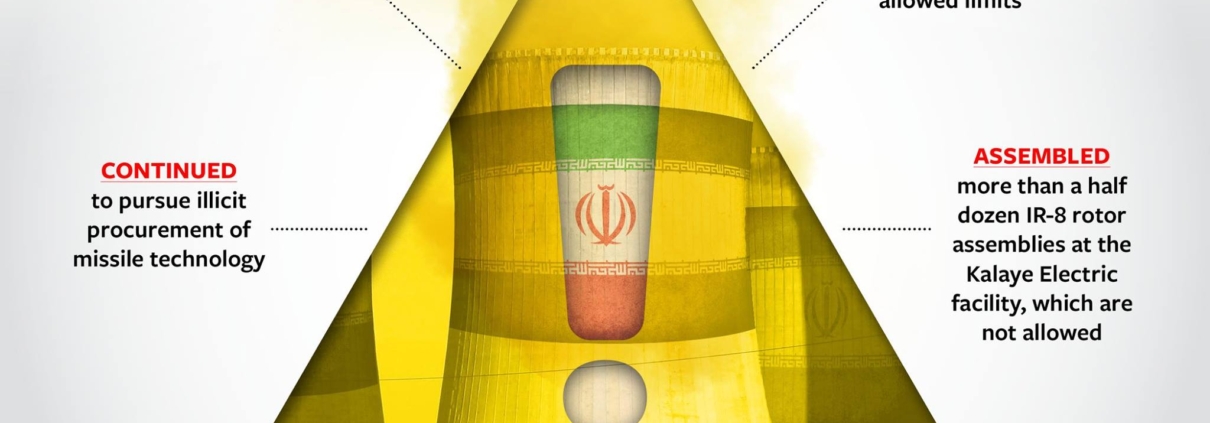
  • What Is The Joint Comprehensive Plan Of Action (JCPOA)? This is the official name of the agreement that was negotiated between Iran and the Obama Administration, the U.K., France, Russia, China, and Germany in 2015, which is intended to stop Iran from acquiring nuclear weapons. In exchange for placing limits on its nuclear program, Iran received relief from oil and financial sanctions, including roughly $100 billion in previously frozen assets. Crafted explicitly to get around Congressional opposition, the JCPOA was also submitted by the Obama Administration to the U.N. Security Council for approval before Congress had the chance to even review the controversial agreement, which irked legislators from both parties.
  • Why Is The President Required To Certify Compliance Every 90 Days? Due to these concerns about the JCPOA and the way it was implemented, Congress passed the Iran Nuclear Agreement Review Act of 2015 (INARA) as a way to reassert themselves in the process. Among other provisions, this law requires the President to certify to Congress that Iran remains in compliance with the JCPOA every 90 days.
  • Why Did President Trump Certify The Iran Deal Twice Already? He did so “reluctantly,” giving his Administration more time to determine the way forward on this issue. The Administration is also currently undertaking a six-month comprehensive Iran policy review, which is expected to be completed by an October 31st deadline.
  • What Happens If The President Doesn’t Certify Compliance This Time? The JCPOA does not immediately become null and void. Instead, Congress will have 60 days to decide whether to reapply sanctions against Iran. If Congress does reapply sanctions, this move would violate the terms of the JCPOA, although the exact consequences in this scenario are unknown beyond speculation.
  • Does Iran Appear To Be In Compliance With The Deal? While proponents of the deal note that the deal “relies on verification,” the International Atomic Energy Agency (IAEA), which oversees this verification, does not have access to certain Iranian military sites. In addition, Iran attempted to buy illegal nuclear technology 32 times since the deal was implemented. However, the Chief of the IAEA says that Iran is upholding its compliance, despite having never fully certified this claim.
  • Where Do The Key Players Stand? President Trump has accused Iran of violating the “spirit” of the deal, and is expected to announce that he will not certify compliance – a move supported by U.S. Ambassador to the U.N. Nikki Haley and national security hawks in Congress like Senator Tom Cotton (AR). In addition, European allies who helped negotiate the deal will likely, if begrudgingly, end up going along with the U.S. should it reapply sanctions. However, Secretary of State Tillerson and Defense Secretary Mattis support remaining in the deal while working to improve aspects of it, and Iran has said it could walk away from the deal if the U.S. does not uphold its commitments.

Given the space between what the President and some of his advisors are saying, the way forward may ultimately be more symbolic rather than substantial by putting the onus on Congress to act or not act on the deal’s future.

News You Can Use

YOU’VE BEEN FOIA’D

College students in Virginia are about to hear a lot more about the state’s upcoming off-year elections than they expected. While they are likely familiar with organizers coming to campus to register voters, they may be surprised to learn that a left-leaning environmental group is about to invade a lot more of their safe space. Through Freedom of Information Act (FOIA) requests to every state-supported college and university in Virginia, progressive political group NextGen Virginia received the public, personal information of around 40,000 current students at Virginia Tech, Radford University, and 16 other schools.

NextGen Virginia, which is part of billionaire environmentalist Tom Steyer’s political organization, requested publicly available student directory information such as names, phone numbers, emails, and addresses in order to help register and turn out millennial voters in November’s off-year election. While some universities concluded they must provide the information under FOIA, others cited it in their refusal to furnish the same. What remains to be seen is whether this tactic will become commonplace during future political campaigns, or if it will generate enough public opposition and legislative action to render it politically untenable.

IS FREE TRADE TOO HARD?

Has support for free trade eroded because trade and logistics are complex? According to Ryan Peterson, yes. Peterson is the CEO of software startup Flexport, which helps eliminate the complexity of global trade and logistics. In lowering the barriers that prevent more people around the world from fully participating in connected commerce, he suggests that millions more can be pulled out of poverty.

But can making trade easier really make it more popular? A survey by the Pew Research Center showed that people hurt financially by free trade agreements oppose them by a ratio of nearly two to one. If Flexport and other such technology initiatives hope to change these attitudes, they will need to make sure the benefits of their innovations reach the people and regions who have been hurt by trade in the past.

A NOT SO CHARITABLE DONATION 

When political donors are caught in scandal, candidates and party committee often donate these tainted contributions to charities to help distance themselves from the controversy. Not surprisingly then, after Democratic megadonor and film producer Harvey Weinstein admitted to sexually harassing women over the past three decades, the Democratic National Committee (DNC) followed this well-worn path. However, their charitable donation was not that charitable, perhaps due to the trouble the committee has had raising money.

The DNC donated just 10% of the $300,000 Weinstein has contributed to it over the years, and gave those funds to left-leaning women’s groups such as EMILY’s List, Emerge America, and Higher Heights that will likely spend the funds in ways that  further the political goals of the liberal grassroots. Despite headlines to the contrary, these facts suggest that the DNC is doing little more than window dressing in confronting its association with the Hollywood mogul.

THE FEARLESS GIRL FALLACY 

In advance of this year’s International Women’s Day in March, a bronze statue of a defiant girl was placed in front of Wall Street’s iconic Charging Bull statue. The statue, entitled Fearless Girl, was commissioned by State Street Global Advisors as part of their push to encourage more women onto corporate boards and was a viral success.

However, with news that the firm’s parent company just paid $5 million to settle allegations it underpays women and minorities, the Fearless Girl campaign looks less like simply putting gender and diversity issues “front and center,” and more like a proactive measure to mitigate the fallout from a federal investigation into their contracting practices. In the end, this story serves as further proof that messaging alone cannot bridge a credibility gap if the facts do not support doing so.

HOW MUCH TO TRUST?

Author Rachel Botsman co-parented her three year old daughter with Amazon’s Alexa Voice Service for a few days and described how her daughter’s “easy embrace of Alexa,” was “slightly amusing but also alarming.” Her daughter’s embrace of Alexa was not unusual, and is endemic of the broader trend of robots increasingly becoming integrated with everyday life.

As companies create new technologies that become central parts of our daily routines, Botsman writes that people are no longer “trusting machines just to do something, but to decide what to do and when to do it.” This shift raises questions about how these technologies will be used and regulated in the future. Companies, policymakers, and the public will need to think through the implications of this new era, and how to create policies for it.

Tackling the Fake Account Challenge, Anti-Trump Economy, and Bitcoin Over Bolivars

Here’s What You Need To Know

This week, Facebook provided to Congress more than 3,000 ads that ran during the 2016 presidential election. These ads are linked to a Russian ad agency and were turned over to the House and Senate intelligence committees, as well as the Senate Judiciary Committee, as part of the tech company’s cooperation with the investigation into potential Russian meddling in the election.

Facebook is not the only tech company facing scrutiny. Twitter and Google are also cooperating with the probe, and the result of this scrutiny thus far is an increasing public awareness of online influence, fake social media accounts, and automated internet “robots”, or “bots” for short. Taken together, these unfolding developments present a challenging reality at the intersection of technology with government, business, and politics.  

Whatever the outcome of the investigation into Russian election meddling, the issue of fake social media accounts is one that business leaders and policymakers will need to grapple with. No matter what steps social media companies take to deter these accounts, they are likely to be a fact of life for some time, if not forever. With that in mind, as we often say at Delve, what you don’t know can hurt you, so here are three important lessons for tackling the fake news challenge before it undermines your interests:

  1. Know These Fake Accounts Exist: Fake social media accounts are not a new phenomenon. There were more than a dozen services selling fake Twitter accounts as long ago as 2013; Facebook has been responding to claims since at least 2014alleging that it gave “fake likes” to companies in exchange for advertising dollars; and Twitter accounts were used in 2015 by supporters of Mexican President Enrique Nieto to push back against political opponents and diminish unfavorable narratives. When you see a new meme or line of messaging beginning to trend, you need to step back and understand that it is in someone’s interest to promote that messaging beyond its organic interest.
  2. Know Who’s Behind Them And Why: Web traffic is a valuable commodity, whether as a tool to drive advertising revenue and demonstrate popularity, or as a means to further a political objective. While one Facebook imposter account was traced back to the Russian government as a means of stirring chaos in the United States, companies, bands, and even the U.S. State Department have paid companies to artificially inflate their social media followings and create an echo chamber effect artificially.
  3. Leverage This Information: Business leaders and policy makers need to understand the challenges posed by fake social media accounts, which pose serious political and reputational risks for companies and causes. Fake accounts already exist and are creating perceptions that may not stand up to scrutiny; investors are already questioning the effects that fake accounts have on advertisers and the values of social media stocks; and companies have already been caught – and their brands damaged – by creating fake accounts to try and shape a narrative online. Indeed, fake accounts are in many ways the latest method in a longstanding tradition in Washington and other influence capitals of creating anonymous, anodyne-sounding coalitions to promote messages and undertake advocacy for and against business and policy concerns. If business leaders and policymakers wait to achieve an information awareness about these accounts, the ability to prepare for and mitigate the risks they bring will be greatly diminished – and may raise the costs for eventual recovery from them.

Fake accounts will remain a major issue in the news, and their activities and consequences will continue to impact businesses and create challenges for policymakers. In looking at these facts, and by using the three lessons outlined above, one can better understand the risks that fake accounts pose and be better prepared to craft a strategy to protect one’s interests and make the most of the opportunities that present themselves in these uncertain times.

News You Can Use

DUELING ECONOMISTS AND THE MINIMUM WAGE

Does the minimum wage hurt job creation? In finding the answer to this question, University of California-Irvine Professor of Economics David Neumark writes that this debate “often reduces to dueling economic studies.” Almost on cue, Berkeley Professor Michael Reich challenged Neumark’s suggestion that his criticism of a study on Seattle’s minimum wage increase harming low-wage workers may have been driven by ideological, rather than empirical, motivations.

At issue for Neumark is that the methodology often used in studies cited by minimum-wage supporters, in which workers in geographic areas nearby are used as the research control group, is attacked by those same supporters when the Seattle study shows low-wage workers being harmed. Neumark, who believes the effects of minimum wage changes can be masked by broader trends or policy differences in different geographical regions, closes with this advice for one who attempts to evaluate further studies on the issue: “understand not only what the research says about public policy, but also who the messenger is.”

CAN LOCAL JOURNALISM BE SAVED?

As big newspapers like The New York Times and Washington Post profit and hire more journalists, local journalism continues to decline and shed jobs. Enter Report For America (RFA), which aims to reinvigorate local journalism by placing 1,000 journalists in local newsrooms over the next five years. Calling the crisis in local journalism a “crisis for our democracy,” RFA will select emerging journalists and connect them with newsrooms in need. Fifty percent of the journalists’ salary will be paid by RFA, which is funded by Google News Lab and private donors, with the remaining half being split between the local newsroom and local donors.

While RFA will increase the pipeline of personnel flowing to local newsrooms, the crisis confronting journalism may not be one of personnel, but rather one caused by the lack of a sustainable business model. Therefore, unless local newsrooms find a wealthy benefactor or alter their business models, this surge of journalists alone is unlikely to save local newsrooms.

THE ANTI-TRUMP ECONOMY

The political ecosystem in opposition to President Trump is booming. Termed the “anti-Trump economy” by The Washington Post, this ecosystem includes everything from director Rob Reiner founding a Committee to Investigate Russia, to former Obama staffers’ Pod Save America podcast tour selling out 6,000-seat venues, to liberal groups MoveOn.org and Indivisible holding a joint conference call with 60,000 participants – a number now enshrined in the Guinness Book of World Records. Flush with cash and support, liberal groups are using these resources to expand their activism.

Yet for all the motion, there has been very little electoral progress thus far. With the high-profile Democratic losses in special elections in Georgia and Montana, it remains to be seen whether this grassroots enthusiasm will be enough to overcompensate for the Democrats’ inability thus far to connect with voters beyond their extreme base.

A WILD AND “CRAZY GUY?”

In an effort to better understand the American President, and why top officials like Secretary of State Tillerson and Defense Secretary Mattis publicly contradict him so often, North Korean officials have been quietly reaching out to Republican-linked policy analysts and ex-officials for meetings in neutral locations. The situation has since gotten more confusing as President Trump took to Twitter to tell his Secretary of State to “save his energy” instead of trying to negotiate with North Korean officials.

The tweet came just one day after Tillerson said the U.S. had direct lines of communication to Pyongyang. However, in light of the President’s urging of staff to portray him as “a crazy guy” in trade talks as a means of gaining leverage in negotiations, Trump’s actions regarding North Korea may be viewed instead as a calculated extension of the Madman Theory of international relations.

LAWYERS WITHOUT FACTS

A recent letter signed by faculty of Georgetown’s law school highlighted the importance of using facts as the foundation of any public affairs initiative. In advance of Attorney General Jeff Sessions’ appearance at the school to discuss free speech on college campuses, 30 faculty members signed a public letter lecturing Sessions for perceived “hypocrisy” on the issue. Among the examples cited by the faculty included the Justice Department prosecuting an activist for “laughing” during Sessions’ confirmation hearing and his supposed directive that the Department of Justice would not pursue federal investigations into police shootings of unarmed black men.

Both accounts do not stand up to scrutiny. The U.S. Attorney’s office in charge of prosecuting the disruptive activist was overseen by an Obama appointee, and while many characterized it as being prosecuted for laughing, in reality, according to prosecutors she “grew loud and more disruptive” after police tried to “quietly escort” her from the hearing, “eventually halting the confirmation hearing.” In regard to the latter charge, Attorney General Sessions has said that his department will “hold accountable” any law enforcement officer who violates civil rights by using excessive force – and indeed extracted a guilty plea from an officer accused of doing just that. Instead of galvanizing support for their perspective, the faculty’s trouble with the facts may instead have undermined their cause.

BITCOIN OVER BOLIVARS

An extreme cash shortage is creating serious problems for the people of Venezuela, and in a country where a third of the population does not have a bank account, cash is essential for survival. When people do get their hands on Venezuelan currency, Bolivars, runaway inflation ensures that it is almost entirely worthless.

Enter Bitcoin, the internet cryptocurrency that locals are now using to pay for lunch and other daily needs. Venezuelans are increasingly relying on Bitcoin as the Bolivar continues to tank. While not without criticism, Bitcoin’s ability to help people function economically in places where government-backed financial instruments have faltered may well lead to the first “Bitcoinization” of a sovereign state.

The Great Shakedown, You Are Where You Live, and Knowing What’s Disclosed

Here’s What You Need To Know

With a strong stock market and a political agenda that includes tax reform, repealing and replacing the Affordable Care Act, and reducing regulations, Wall Street banks and investors are optimistic about the future of the U.S. economy. However, as a result of their settlements with the Obama Administration in the aftermath of the 2009 financial crisis, Wall Street’s big banks are incidentally funding the opposition to the very policies they support.

Intended to assist individuals who lost their homes in the housing crisis, some of the Department of Justice (DOJ) and Department of Housing and Urban Development’s (HUD) $640 million in settlement funds have instead been dispersed to Democratic activist groups who were not victims of the crisis, but were selected to “provide assistance to [consumers] and communities most in need of help.” Bank executives, industry groups, and policy experts alike have expressed concern regarding the usage of these funds – which resemble a “slush fund” for third-party groups selected by the executive agencies – because they seem to be going towards policy advocacy rather than helping victims.

Here are three examples of nonprofit groups that were selected by Obama’s DOJ and HUD to receive settlement funds collected from Wall Street banks – and how these groups may be misusing these funds:

1.     The National Council Of La Raza – Rebranded as UnidosUS, this controversial Latino-rights group received $1.5 million in bank settlement funds from the Obama Administration. After coming out strongly in opposition to Republican efforts to repeal the Affordable Care Act, this group organized large rallies targeting vulnerable legislators in a successful effort to kill the bill.

2.     National Urban League – This African American advocacy group received at least $1.2 million in bank settlement funds and attacked the Republicans’ alternative to the Affordable Care Act as “un-American, un-healthy, and un-caring.”

3.     National Community Reinvestment Coalition – At the forefront of opposing the regulatory repeal of provisions in the Dodd-Frank Wall Street Reform and Consumer Protection Act, as well as blocking the privatization of Fannie Mae and Freddie Mac, this liberal advocacy group received $2.6 million in Obama-era settlement funds.

In a change of policy meant to remedy this practice going forward, Attorney General Jeff Sessions announced the DOJ would no longer set aside settlement funds for third-party interest groups or political allies, and that settlement funds will only be used “to compensate victims, redress harm, and punish and deter unlawful conduct.” Yet, the Consumer Financial Protection Bureau (CFPB) – which is currently led by an Obama Administration holdover – continues to donate from its Civil Penalty Fund to third-party groups, with entities as varied as the Government Accountability Office and the Independent Community Bankers of America calling for increased transparency and reform.

By bringing the scope of this “shakedown” to light, those who are skeptical of Obama-era financial regulation and enforcement efforts are wagering that an educated citizenry will find the practice distasteful and become more sympathetic to their arguments for repealing or at least revising them. There is evidence that this may be a sound strategy, and barring any change in CFPB Director or settlement policy, understanding how settlement funds are being used – and to what end third-party interest groups may be benefitting – will be a crucial part of this issue going forward.

News You Can Use

YOU ARE WHERE YOU LIVE?

Economic opportunity in America is more closely tied to one’s location than ever before, and people living in the most distressed zip codes are finding less opportunity and a widening gap between them and people living in the most prosperous areas. Technological disruption has only exacerbated this schism, and with fewer businesses starting up than shutting down, especially outside major metropolitan areas, this regional inequality contributes to a large number of Americans facing hard times and feeling left out in today’s economy.

Noted urbanist Richard Florida, who in 2002 predicted a resurgence in city centers due to a new class of creative “knowledge workers,” proposes federalism as a means of creating solutions to this growing economic segregation. With people being left behind in zip codes throughout different regions of the country, Florida suggests that giving power from the federal government back to local actors is the best way to help create areas that are more inclusive economically.

IF THERE’S A WILL…

Is this week the last chance Republicans have to repeal Obamacare? The media would have you believe it is. Even Speaker Ryan has said that the most recent vehicle for this goal, the Graham-Cassidy health care bill, is the “best, last chance to get repeal and replace done.” However, long-time Congressional health policy aide Chris Jacobs argues this view is based on a Senate parliamentarian’s ruling that is not binding and has no precedent.

The central question in this ruling is whether so-called reconciliation instructions, which allow for the Senate to expedite legislation dealing with fiscal issues, expire. Because there is no precedent and the parliamentarian’s ruling on this issue is not binding, a majority of Republicans themselves can set the precedent going forward by voting to pass repeal legislation beyond September 30th. Alternatively, they can also choose to pass a new budget with reconciliation instructions once the previous one expires, although that may interfere with tax reform efforts. Whatever the way forward from here, Jacobs contends Republicans have more time to finally deliver on their seven years of promises to repeal Obamacare – if only they can muster the political will to do so.

THE MISEDUCATION OF UNCLE SAM

In the continuous debate regarding how to improve educational outcomes for impoverished and minority students in the U.S., the ideas commonly focus on government policies such as affirmative action, quotas, and lower admission standards. However, at BEAM – a nonprofit in New York City whose mission is to create pathways for underserved students to enter into STEM fields, the focus is not on government but rather on helping students “fall in love with math.” By identifying and nurturing underserved students with the raw ability to succeed in high-level mathematics, BEAM demonstrates that part of the solution to the most difficult public policy challenges may not be through government – but through a strong and vibrant civil society.

KNOWING WHAT’S DISCLOSED

Despite a law banning Members of Congress from insider trading in the wake of an explosive 60 Minutes report, legislators and their staffers continue to buy and sell stocks of companies that have interests before their committees. This revelation can be gleaned from reviewing Personal Financial Disclosure (PFD) forms, which are publicly available and required of all Members of Congress, as well as Congressional aides making above a certain salary.

In addition to information about their incomes, assets, and liabilities, aides must also disclose most financial transactions, such as stock trades made during the year by them, their spouses, and dependent children. While legislators and their staffs may deny any insider knowledge driving their investment decisions, knowing what public information is available to the media, watchdog groups, and engaged citizens is crucial to proactively mitigating the damage from any investments that – if legal – can be perceived as improper.

A NEW DEBT TRAP?

Long considered a cornerstone of the American Dream, home ownership is no longer viewed as an essential part of it. The Great Recession caused by the housing “bubble” remains fresh in many Americans’ minds, and especially for millennials, the experience of coming of age during the financial crisis created skepticism regarding the benefits of home ownership. Adding to this skepticism is the fact that millennials, who used to be considered in the prime age range to buy a home, carry an estimated $1 trillion in student loan debt.

In an effort to encourage millennial buyers to purchase a home that they are putting off because of this debt, homebuilders and mortgage companies are creating a program, backed by Fannie Mae, to cover up to 3% – up to $13,000 – of a buyer’s outstanding debt. Loftium, another homebuyers’ assistance program, is offering buyers up to $50,000 for a down payment in exchange for continuously listing an extra bedroom on Airbnb for several years and giving a majority of the income to Loftium. Even so, these moves to increase home ownership may create new challenges to be solved. Besides concern that assistance programs will drive up home prices, they may also ultimately contribute to luring homebuyers into a new debt trap by making it easier for them to accumulate new debt.

Getting by With a Little Help From Friends, Mystery in Cuba, and Is UBI No BFD?

Here’s What You Need To Know

These days, individuals and groups with cases before the Supreme Court are getting by with a little help from their friends. In fact, over 90% of cases that the Supreme Court hears attract at least one amicus curiae – Latin for “friend of the court” brief. That is a more than 800% increase since the 1950s, and a 95% increase since 1995.

Amicus briefs are a tool for individuals or groups that have an interest in – but are not a party to – a case that allows them to provide an outside perspective to be considered by the judge. As the primary way for interest group participation in the judicial system, and in an effort to prevent well-funded litigants from stacking the deck in favor of their interests, the Supreme Court and federal appeals courts have required friends of the court to disclose if their brief was written by a party in the case or whether they were paid to do so.

However, recent headlines have brought to light hidden ties to big investors behind amicus briefs. Here are some of the questions raised by the lengths that well-funded litigants will go to in order to get around disclosure requirements:

  • Why Are There Disclosure Requirements? The purpose of the disclosure requirements are to make clear if a filer is a party to a case or being paid by the party to submit their brief.
  • What Tactics Are Being Used To Get Around Disclosure Rules? In one instance, a major law firm wrote an amicus brief on behalf of a nonprofit that supported their client’s interests and recruited a different lawyer to be “involved for five minutes” and sign her name to it, thereby avoiding the need to disclose their involvement. In another example, a consulting firm recruited allies to file briefs on behalf of their client’s interests and obfuscated their involvement by diverting payments through other entities in order to help their clients succeed.
  • Why Are These Tactics Being Used? Litigants and others use amicus briefs not only to influence the court, but to influence public opinion as well. When coupled with a press release and media strategy, it creates an artificial perception of wide-range support that generates buzz on behalf of their cause.
  • What Does The Way Forward Look Like? With the proliferation of this tool, those involved in public policy battles that involve the courts need to know the full nature of what they are up against. That includes following the money, uncovering hidden motives, and understanding who is really behind amicus briefs and other influence efforts. Such competitive intelligence builds a stronger foundation for a successful public affairs strategy.

News You Can Use

IS UBI NO BFD?

This week, former Vice President Joe Biden pushed back against Universal Basic Income (UBI) as he launched the Biden Institute at the University of Delaware. In a blog post, Biden painted UBI as a “government check with no strings attached,” and instead insisted on building “a future that puts work first.” In particular, he suggests education, workplace benefits and protections, and support for communities burdened by transformation. Due to the technological disruption in the 21st century, UBI has been gaining steam as a solution to inequality and unemployment among titans of Silicon Valley, as well as by voices on both the left and right.

Biden’s focus on the value of work as part of the solution to technological disruption, rather than on a “government check” through UBI, is in stark contrast to Bernie Sanders, who has repeatedly called for guaranteeing a “minimum standard of living” to all Americans through government action. The Democratic party has not always stood for just another “government check,” as demonstrated by FDR’s work programs and Clinton’s support of welfare reform. Whether Biden’s views are an appraisal of the passing scene in his role as an elder statesman, or a sign that someone is starting to push back on the party’s leftward lurch, remains to be seen.

“BREXIT” OR “BRICS – IT”?

 The “BRICS” nations of Brazil, Russia, India, China, and South Africa are thought to represent the future of the global economy. However, a look at the performance of 74 world economies since the turn of the century shows that a number of smaller countries like Vietnam, Bangladesh, Uzbekistan, and Sudan have outperformed larger countries like Brazil, Russia, and South Africa.

While China and India have seen dynamic growth, much of the promise of the “BRICS” – which make up 40 percent of the world’s population and more than a quarter of its land – remains unfulfilled. In an age where Britain is leaving the European Union, Angola’s economy is outperforming Brazil’s, and tensions are rising between “BRICS” members over policy disputes, the durability of the “BRICS” coalition will be tested.

FREEDOM TO GET SUED ACT?

Lawsuits over public records have traditionally been a means of last resort for parties seeking public records from government under the Freedom Of Information Act (FOIA) and its state and local equivalents, but now some government offices are flipping the script, using legal action as a defensive measure to deter requests. Instead of simply confirming or denying public records requests, governments are using lawsuits to stonewall requests for embarrassing or otherwise sensitive information. Even if records are ultimately released, the requester is responsible for legal costs and the government’s actions can intimidate others from requesting records.

Open records laws at all levels of government have been effectively used by watchdogs, journalists, researchers, and individual citizens in order to gain the release of documents and public records. While government officials who have sued requesters say that it’s best for courts to legally determine if records should be released, this trend has concerned freedom-of-information advocates and raises questions about the potential for abuse. With the IRS targeting scandal still fresh in memory and with concerns about civil forfeiture in the news, an ordinary citizen being ensnarled in a legal battle “against a public entity with almost inexhaustible resources” may highlight the need to implement new steps to ensure citizens can hold governments accountable.

MYSTERY IN CUBA

At least 21 American diplomats stationed in Havana, including the top official in charge of security, have been affected by a “blaring, grinding noise” in the middle of the night that has resulted in hearing loss, speech problems, and memory troubles over the past few months. The top U.S. diplomat has called these occurrences “health attacks,” but what is causing them, and who is behind them, remains a mystery.

The Castro government denied involvement, and with Canadian diplomats among the victims as well, even though their government has had cordial relations with Cuba for years, U.S. officials are focusing their investigation on rogue Cuban elements or other state actors. The U.S. embassy remains open as the investigation continues, but concern for the safety of American diplomats may require the U.S. to close the embassy – resulting in further uncertainty regarding U.S.-Cuban relations as President Trump rolls back some of President Obama’s steps toward détente with the Caribbean nation.

LESSONS FROM AMAZON’S WONDERLUST

In announcing its decision to open a second headquarters outside of Seattle, Amazon sent more than 100 municipalities scrambling across the U.S. and Canada to compete for a $5 billion campus and 50,000 new well-paying jobs. This announcement caught Seattle by surprise, and has prompted soul-searching in the city to determine ways to encourage state, local, and business leaders to promote policies that enable companies’ growth.

High-tax and wage policies, rapidly rising housing costs, and traffic congestion are among the frustrations driving Amazon’s search for a “stable business climate for growth and innovation.” Yet in its search for cities willing to give it the most generous corporate tax breaks, which includes cities with deep fiscal challenges, Amazon is tempting state and local leaders to put taxpayers on the hook, which could result in the same high-tax policies they are fleeing in the first place.

Declaring an Opioid Emergency, Trudeau’s Art of the Deal, and Will AI Crown a “Ruler of the World”?

Here’s What You Need To Know

In late July, the President’s Commission on Combating Drug Addiction and the Opioid Crisis, led by New Jersey Governor Chris Christie, issued a preliminary report recommending, among other steps, that President Trump declare the opioid abuse epidemic as a national emergency. A couple weeks later, President Trump stated he was likely to do so. Although the President offered no additional details, his comments were widely interpreted as accepting this recommendation. However, over a month later, the President has yet to act and the Administration is still debating the proposal internally.

Declaring a national emergency would do little to change current policy by itself, but the move would provide various members of the executive branch with new powers under either the Public Health Service Act or the Stafford Act (which governs federal disaster response efforts) that could be used at their discretion. Many in the media are presenting this action as a no-brainer, but is it actually a good idea?

Here are the main arguments for declaring a national emergency:

  • It Would Allow The Administration To Free Up Greater Resources: Current law limits the extent to which the Federal Emergency Management Agency (FEMA) and the Department of Health and Human Services (HHS) can redeploy its budget and personnel to help tackle this issue. In addition, Medicaid restricts at what hospitals some drug users can receive treatment. Declaring an emergency would allow the President to authorize FEMA to direct some of its budget towards the crisis, while letting HHS Secretary Price redeploy public health workers to serve addicted populations and waive these Medicaid rules.
  • It Would Allow The Administration To Increase Access To Critical Medications: Currently, patients must have a prescription to access a drug called naloxone that can reverse overdoses. In addition, doctors must have special certifications to prescribe drugs like methadone and buprenorphine, which help reduce cravings and withdrawal symptoms. Under a national emergency, the HHS Secretary would have the authority to waive restrictions for patients and doctors on these types of drugs.
  • It Would Increase Pressure On Congress To Act: Last year, lawmakers passed a bill to expand funding for opioid programs, but only included half the money President Obama requested. The commission argues that if President Trump declares a national emergency, Congress will also want to show it is taking action, forcing them to “focus on funding and empowering the executive branch even further.”

Here are the main arguments against declaring a national emergency:

  • It Would Divert Resources From Other Priorities: Money taken out of FEMA’s budget would have to be taken from other important areas, such as FEMA’s disaster relief fund. As Hurricane Harvey and Irma have shown, it is difficult to anticipate when major disasters will strike and depleting these funds could make it more difficult to respond when these events happen. Redeploying public aid workers would also remove these workers from other critical work, such as AIDS outreach.
  • It Would Lead To An Unnecessary Expansion Of Executive Power: Emergency declarations have historically been used to tackle temporary problems that are contained within a specific place like hurricanes, earthquakes, and the Zika virus. In contrast, the opioid crisis is spread across the entire country and likely will never be completely eradicated. Doing so in this case could establish a new precedent where presidents feel compelled to declare emergencies in response to every problem. The result would be to permanently give the President powers that were designed to only be temporary.
  • It Would Create A False Sense Of Action: Declaring an emergency may sound bold, but the funds it would free up would only be a small Band-Aid relative to the scale of the problem. FEMA’s Public Health Emergency Fund has an annual budget of only $45 million; in comparison, the 2016 21st Century Cures Act allocated $1 billion over two years to the problem of opioids. If the public views a national emergency declaration as sufficient, it could undermine the urgency for further legislative action.

News You Can Use

TRUDEAU’S ART OF THE DEAL

President Trump has repeatedly attacked the North American Free Trade Agreement (NAFTA) as creating an uneven playing field for American workers. Now Canada seems to be flipping the script on him. As part of the second round of NAFTA renegotiations in Mexico City earlier this month, Prime Minister Trudeau’s government argued right-to-work laws in 28 U.S. states are putting unionized Canadian workers at an unfair disadvantage, pushing the Trump Administration to pass legislation nullifying them.

Canada likely understands the improbability of a Republican Congress doing so, or these states allowing such an agreement, and is attempting to create leverage for other issues like quotas for U.S. dairy products and environmental standards by making a demand Trump cannot possibly fulfill. This development shows that renegotiating trade deals are not just an opportunity for the U.S. to improve its economic standing, but also opens the door for partners to extract concessions as well.

MAKING CRYPTOCURRENCIES LESS CRYPTO

Initial coin offerings (ICOs) to raise funds for cryptocurrencies like bitcoin have grown dramatically in recent years, and governments have begun to express concerns over their use for money laundering and terrorist financing. Last week, China’s central bank announced it was suspending ICOs until the government could develop a regulatory framework for the market.

This decision follows an SEC ruling in July that classified cryptocurrencies as securities, opening the door to criminal charges for anyone holding unregistered offerings. In addition, Singapore’s central bank recently issued a warning about the dangers of ICOs, while Russian authorities made arrests for the first time over the exchange of bitcoin into rubles. With governments cracking down on the market, look for increased calls for international cooperation to develop a common global regulatory framework on this issue.

OUR SELF-FULFILLING GROWTH STAGNATION?

Conventional wisdom since the 2008 financial crisis has insisted that a 3 percent growth rate for the United States is unrealistic. Yet, former Senate Banking Chairman and economist Phil Gramm and US Policy Metrics’ Michael Solon argue that if we lost 3% growth, we lost it for the first time only very recently, noting “America enjoyed 3% growth for so long it’s practically become our national birthright.”

When you retrace our steps, Gramm and Solon suggest, you will find a growth slowdown attributable to an Obama-era “tidal wave of new rules and regulations across health care, financial services, energy and manufacturing [that] forced companies to spend billions on new capital and labor that served government and not consumers,” all of which can be reversed. In addition, although the country is aging, the number of working-age Americans dropping out of the labor market has been the major driver of the declining workforce participation rate. If their argument is correct, the greatest risk to the U.S. economy may be that the status quo is accepted as the new normal and becomes self-fulfilling.

TESLA EXPOSED

Florida Tesla owners in the path of Hurricane Irma who had opted for a 60 kilowatt hour battery option instead of the longer range 75 kilowatt battery option (which costs thousands of dollars more) got a happy surprise as they evacuated: Tesla remotely extended the battery range of their vehicles to help them reach safety. While the company was praised for unlocking the additional battery range, it also raised serious questions. T

he cars these customers had purchased could always have gone that extra distance, because regardless of which battery option customers purchased, Tesla gave them a battery capable of 75 kilowatt hours anyways, but used software to prevent those paying for a 60 kWh version from using the extra storage their car’s battery possessed. With the lines increasingly being blurred between hardware and software, particularly on something as impactful as a means of transportation, Tesla’s business practice could bring increased regulatory scrutiny and potential reputational challenges that will have effects on other industries utilizing “smart” technologies that are artificially limited for those who cannot afford the higher price tag.

WILL A.I. CROWN A “RULER OF THE WORLD”?

While Russia continues its military buildup in the Arctic, President Putin signaled yet another front where a resurgent Russia may challenge the West: Artificial Intelligence (AI). Speaking to a group of Russian students, Putin said, “Whoever becomes the leader in this sphere will become the ruler of the world.”

From automating cyberattacks that currently require dozens of highly skilled personnel, to further eroding trust through the forgery of audio and video material, to improving the precision of aerial drones, AI will be integral to the future of warfare for geopolitical adversaries like Russia and China. However, non-state actors like hackers are weaponizing AI as well. With most AI advances occurring in the private sector and academia, experts are proposing ways to apply AI to U.S. national security policy. However, it remains to be seen whether U.S. policymakers will take Putin’s comment seriously and ensure we are leveraging, protecting, and improving on the AI knowledge that already exists outside of government.

The Rise of Antifa, a Federalist Answer on Immigration, and Replacing Leslie Knope​

Here’s What You Need To Know

In April 2016, the Department of Homeland Security and the FBI issued a confidential joint intelligence assessment labeling a leftist extremist group named Antifa – short for anti-fascists – as “domestic terrorists,” predicting they would engage in violence with radical right-wing organizations.

A few weeks ago, this group finally began to capture the public’s attention as fights broke out between Antifa and white supremacists in Charlottesville. However, even before this incident, Antifa protestors have repeatedly engaged in violent behavior over the past several years in places like Berkeley, Washington D.C., New Orleans, Portland, Chicago, and Philadelphia. This has included beating innocent people, attacking police with clubs, setting cars on fire, smashing windows, and other destructive activity.

In the wake of this violence, there’s been much discussion and debate in the media about what Antifa is and how serious of a threat they pose. So, we want to give a clear, factual view of their history, how they operate, what they believe, who is funding them, and why they are becoming a more significant threat:

  • Where Did They Come From? Antifa can be traced back to an alliance of German Communists and Social Democrats that was founded against Nazism during the Third Reich. In the 1980’s, drawing on this legacy, a loose collection of groups called the Anti-Fascist Action (AFA) was formed in Britain to often violently oppose far-right wing movements. This activity inspired left-wing punk fans in the United States to follow suit by creating their own anti-fascist groups.
  • What Do They Believe? Antifa is primarily comprised of communists, socialists and anarchists. However, their common cause appears to be sowing chaos, attacking police, and shutting down speech from people they disagree with. One Antifa group in Washington advocates for acts of vandalism just to make middle class people “feel a little less safe,” while another in Philadelphia holds workshops called “Our Enemies in Blue,” which celebrate violence against police. Antifa claims they are working to stop fascists and white supremacists, but they often go after events that clearly do not fall into that category, including San Francisco’s “Liberty Weekend,” which was organized by an Asian American and explicitly forbade extreme elements from joining.
  • How Are They Organized? The movement is largely decentralized, and represents more of an amalgamation of loosely affiliated groups throughout the country than any single, unified organization. However, particularly on the West Coast, there are some local bodies, such as Rose City Antifa in Portland, that are more well-organized and active online.
  • Who Is Funding Them? One significant player funding Antifa elements is George Soros, the world’s wealthiest hedge fund manager and a major donor to Democratic and leftist causes. Soros played key roles in crashing the British pound during “Black Wednesday” in 1992 and the Thai Baht during the 1997 and 1998 Asian Financial Crisis.
  • What Is Different Now? The growth of Antifa coincides with growing support from many, especially younger people, for shutting down speech they determine to be hateful or otherwise unacceptable. A 2015 Pew Research poll found 40 percent of Millennials support limiting free speech that is offensive to minorities, although this strain of thought often extends to more mainstream individuals engaging in reasonable  debate. This attitude is especially evident on college campuses where protestors have shut down speaking engagements from conservative speakers like Charles Murray and Condoleezza Rice. In addition, the perception among many on the left that Trump supports fascists has also fueled the surge in Antifa activity. In the three weeks before Trump was inaugurated, NYC Antifa’s Twitter following nearly quadrupled.

Given their growing prominence, Antifa members and those emulating their tactics are likely to be a factor in protests for years to come. As a result, it’s important to separate myths from facts when it comes to analyzing the history, behavior, and activities of these types of extremist groups. Once they are understood, it’s possible to better identify when protest movements may be evolving into something more dangerous.

News You Can Use

JOURNALISTS’ TWITTER BUBBLE?

Many have argued that the rise of news consumption through social media is increasingly creating distinct ideological echo chambers across the political spectrum. Yet, this change may not only impact which news the public hears about, but also how news is shaped in the first place. Data scientists at the University of Northeastern recently analyzed the Twitter accounts of 1,000 journalists, finding a correlation between the political leanings of the people these journalists follow on Twitter and the ideological bent of the news content they produce.

It is unclear to what extent the journalists’ choices on who to follow on Twitter are changing the nature of their news coverage or simply reflect their pre-existing biases. However, this study shows that even journalists often become caught in echo chambers, and those seeking to influence journalists must understand how to break through these news bubbles.

IS FEDERALISM THE ANSWER FOR IMMIGRATION POLICY?

Immigration has long been seen as an issue over which only the federal government has jurisdiction over, but a new proposal seeks to delegate parts of this authority to the states. U.S. Senator Ron Johnson (R-WI) recently introduced the “State-Sponsored Visa Pilot Program Act,” which would allow for around 500,000 foreign guest worker visas to be managed and doled out by states, allotting at least 5,000 visas per state with the rest divided up by population. States would also be given the discretion to determine the skill levels or industries that would be eligible.

This flexibility would allow states like Wisconsin (where thousands of manufacturing jobs remain unfilled) and California (where millions in crops have gone unharvested due to the lack of workers) to fill labor shortages; states with higher unemployment rates could opt out of the program. In addition, it could defuse some of the divisive nature of immigration by letting red states and blue states choose their own approach. As a result, Johnson’s bill could be a way to help close the gap between Democrats who support expanding immigration and Republicans who favor states’ rights.

THE THREAT OF GREEN TERRORISM

Jamie Bartlett – a journalist whose focus is how technology impacts terrorism and radical political movements – claims terrorism from the environmental left is the next major threat. Although militant environmentalism is nothing new, Bartlett argues these “green” activists are increasingly turning to illegal and violent tactics due to a rising grievance culture and frustration with what they deem as the ineffectiveness of peaceful methods.

Bartlett provides tangible evidence to this trend, pointing to the violent activity on display during the Dakota Access pipeline (DAPL) protests, a recent terrorist attack on civilians by a radical environmentalist group in Brazil, and a report from the Department of Homeland Security warning of the potential for more attacks on energy infrastructure.

During the DAPL standoff, we at Delve saw this rising problem firsthand when we had the opportunity to help North Dakota law enforcement push back against false claims of police malpractice and reveal the attacks on people and property from many of the protesters. As we did in North Dakota, it is critical to monitor activists and anticipate their actions to protect people and assets in the energy industry and beyond.

WILL CHATBOTS REPLACE LESLIE KNOPE?

A great deal of socioeconomic debate in recent years has centered on the impact of automation on private sector employment. However, because government often lags behind, there has been less discussion on how technological developments could affect public sector jobs.

In recent months, cities like Kansas City, North Charleston, and Los Angeles have begun installing automated chat platforms or chatbots to guide residents through the process of requesting or accessing public services online, reducing costs and improving accessibility of services and information for taxpayers. Kansas City is even using a Facebook chatbot to answer questions on how to navigate its open data portal. Just as taxi cab drivers fought car sharing services in several cities, will public sector unions fight against adoption of these types of technologies that threaten their membership?

FREE SPEECH V. PROPERTY RIGHTS ON SOCIAL MEDIA

legal battle between LinkedIn and a data mining start-up called hiQ could have major ramifications for what is considered public on social media. HiQ built its business around scrapping data from public LinkedIn profiles, but in June the networking site sent them a cease-and-desist letter demanding they stop this activity. The letter argued hiQ was violating the Computer Fraud and Abuse Act (CFAA), which was passed in the 1980s to criminalize hacking. In response, hiQ sued LinkedIn, asserting the right to access public profile data is protected by the First Amendment.

Last week, a U.S. District Judge issued an injunction in favor of hiQ. But the ruling did not address whether their activities constituted copyright or trespassing under the CFAA, and the case is likely to continue to higher courts. Regardless of the case’s outcome, it highlights how outdated many of the laws governing the internet are and how difficult it is for companies to navigate them to ensure they are engaging in lawful practices.

I’LL TAKE A LOAN WITH MY RIDE

Consumers in countries without reliable banks and financial institutions are now finding these services through an unlikely source: ride-sharing companies. As many as 2 billion people throughout the world lack access to traditional financial services. Many of these same people in countries like Kenya and Indonesia increasingly have access to smartphones, though, and use ride-sharing platforms.

As a result, many ride-sharing companies in these countries, such as South East Asia’s Grab, have seized on this opportunity by allowing their customers and drivers to use the app as an “e-wallet” to pay restaurants, retail establishments, and other vendors. This trend follows other tech companies like Ali-Baba and WeChat using their platforms to become the dominant payment processors in China. If tech companies are successful with dual- or multi-use features of their platforms in the developing world, look for them to seek opportunities to complete in developed countries in the long term.

NAFTA Talks, Enviro Attacks Go Low, and How Real News Becomes Fake​

Here’s What You Need To Know

At a Tuesday rally in Arizona, President Trump said current efforts to renegotiate the North America Free Trade Agreement (NAFTA) are likely to fail, and “we’ll end up probably terminating NAFTA at some point.” The Mexican peso plunged in response to his comments. But, is this really a reflection of the status of negotiations, or is the President just posturing to gain leverage and/or appeal to his political base?

Only a few days before Trump’s comments, representatives from the three NAFTA nations concluded the first round of negotiations, where they outlined their preliminary positions. Here are some of the key issues they discussed that could potentially hold up a deal:

  • Made In North America: The Trump Administration is pushing to increase the percentage amount that any finished product must contain of North American materials to qualify as exempt from tariffs under NAFTA. Trump also wants to create a minimum threshold for U.S.-specific materials to help close its trade deficit with Canada and Mexico. This rule is particularly important for the auto industry, where cars must contain at least 62.5 percent American, Canadian, or Mexican materials. While the other Canada and Mexico have expressed a willingness to tighten these rules, both nations voiced strong opposition to creating nation-specific standards.
  • Bi-National Courts: During the original NAFTA talks 30 years ago, then-Canadian Prime Minister Brian Mulroney walked away from negotiations until the Americans agreed to include a provision called Chapter 19. This rule created binational panels to settle complaints of trade violations, moving cases out of the domestic court system. The Trump Administration wants to abolish Chapter 19, arguing it infringes on America’s judicial sovereignty. However, Trudeau’s government has so far maintained Canada’s “red line” on this issue. Mexico has been somewhat critical of Chapter 19, but does not support moving these cases into domestic courts. While it may be possible to reach an agreement on updating these bi-national panels, it appears unlikely Mexico and Canada will consent to the U.S. demand to scrap it entirely.
  • Dairy Wars: In April, President Trump attacked Canada’s quotas on U.S. dairy as a “disgrace,” arguing these trade restrictions have hurt U.S. farmers. In negotiations, his administration is pushing for the elimination of these quotas. However, Canadian Prime Minister Justin Trudeau has already pushed back against this demand, pointing out that the U.S. has a $400 million dairy surplus with Canada. Since this system of quotas is deeply entrenched in Canada, it seems implausible they will be willing to concede much ground in this area.

Round two of negotiations is scheduled for the first week of September in Mexico City, with five more rounds expected to take place into early 2018. While it remains unclear if these issues can be overcome, political considerations in all three countries may drive their leaders to try to get a deal done sooner rather than later.

With Mexico’s presidential election in the spring and the U.S. midterms next fall, both Trump and Nieto may be less willing to make politically risky concessions during their respective campaign seasons. As a result, the next few months will likely be make or break for whether this bid will be successful, and if Trump’s threats are to be taken seriously, whether NAFTA can persist into the future at all.

News You Can Use

WILL THEY CALL IT THE DRAVIS RULE?

Attacks on high-level presidential appointees have long been standard political practice, but environmental groups are taking this practice to the next level, targeting lower-level Trump staffers for doing nothing more than serving in government. The National Resources Defense Council (NRDC) reported on the hiring of an obscure EPA staffer named Samantha Dravis, claiming she was as an “enemy” of her agency, even though she’s merely leading a standard bureaucratic review that was also done by the Obama Administration.

Green groups have already submitted over 100 Freedom of Information Act requests demanding access to her daily schedule and email. The New York Times parroted these attacks, recently publishing a picture of Dravis on their front page and suggesting she was “a vehicle for corporate donors” in her past job without citing any actual evidence. This new threshold of acceptable attacks contributes to the increasingly coarse civic environment and discourages qualified candidates from seeking to serve in government.

FOLLOWING THE MONEY  

Throughout every election cycle, campaigns on both sides are placed on the defensive for accepting contributions from controversial or ethically questionable sources. A recent article in Roll Call blames this problem on the difficulty of vetting donors, arguing it’s “an impossible job” because of the sheer number of people who give money to a campaign, the challenge of differentiating between individuals with the same name, and the difficulty of vetting people who are not publicly well-known.

However, this ignores how technological advances can be used to efficiently capture the criminal history, web presence, social media activity, and previous campaign contributions of donors. After this information is collected and organized, it becomes possible to sort out who is who and to identify any issues associated with more obscure people. By devoting the proper resources and expertise to vetting donors, campaigns can put out these fires before they get started.

BRAIN DRAIN U.S.A.

Much of the recent debate on immigration reform has focused on how many visas should be given to highly-skilled immigrants. But what if the U.S. cannot keep the highly-skilled immigrants it already has? Several countries are attempting to lure these workers – especially academic researchers – back from the U.S. Established in 2011, China’s fast growing Thousand Talents program provides generous incentives – like relatively high salaries, free medical care, instant tenure, and eligibility to purchase property at discount rates – for Chinese academics who studied in foreign universities to return home.

This year, Canada introduced a Global Skills Strategy program to process 80% of foreign work permit applications from highly-skilled workers within two weeks, while French President Emmanuel Macron started a campaign designed to attract U.S. climate scientists to France. If these initiatives are successful, other countries may launch efforts targeting critical industries like tech, which could place in jeopardy the competitive advantage of Silicon Valley and the U.S. economy.

TECH INDUSTRY’S HUMAN RIGHTS HYPOCRISY

Major tech companies like Apple, Amazon, and Google, have been espousing politically liberal values at home, while complying with the demands of authoritarian governments abroad. Many of these corporate leaders have issued statements criticizing President Trump’s policies on immigration, transgender individuals in the military, and the Paris Climate agreement, all on the basis of concerns over human rights.

However, the companies they lead have a long history of complying with Chinese government censorship of internet freedom and helping to build the country’s cybersecurity infrastructure that may be used to gather personal information on political dissidents or to steal proprietary trade secrets. These same corporations have also helped crack down on internet freedom in places like Russia and Iran. Balancing business objectives with reputational goals is difficult for any multi-national corporations, but disconnects between domestic policy rhetoric and corporate practices abroad can undermine companies’ credibility in such “values” discussions.

A MEDICARE TOURISM WIN-WIN?

AEI Scholar Andrew Biggs is promoting a plan he claims can help tackle two seemingly unrelated policy challenges at once: rising Medicare costs and Puerto Rico’s financial troubles. Biggs suggests compensating Medicare patients who travel to Puerto Rico for significantly cheaper care half the difference between the cost of a procedure on the mainland and on the island. He argues this idea would not only save the government money by encouraging Medicare enrollees to seek out cheaper procedures, but also boost the Puerto Rican economy by increasing medical tourism.

As an ancillary benefit, the proposal could also help address Puerto Rico’s current doctor shortage by creating more jobs for these and other health care workers. As more controversial health care reforms fail to gain traction even as healthcare costs keep rising, look for more of these types of proposals to emerge seeking non-partisan “win-win” opportunities.

HOW REAL NEWS BECOMES FAKE

Lost in the debate over the proliferation of fake news stories is how changes in the presentation of real news are altering the public’s perception of reality. According to writer Tobias Rose Stockwell, the rise of news consumption through social media has increased the incentive of media outlets to write sensationalized headlines to attract clicks and advertising revenue.

However, since many users only read headlines, this limited picture often becomes the de facto perception of the real story. Add in algorithms that target these headlines at users based on their existing biases and fears, and the result is a formula for the rapid spread of half-truths. As a result, having the facts on hand and understanding how individuals and groups are using social media networks to spread misinformation is critical to push back against false narratives.

Pin It on Pinterest