Trump ‘16 Could Be Clinton ‘92
Here’s What You Need to Know
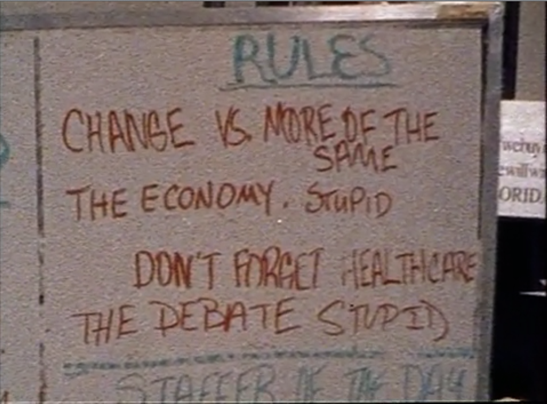
Throughout the 1992 Clinton presidential campaign, three simple messaging elements were posted to a board in the famous campaign “war room”: 1) Change vs. more of the same, 2) The economy, stupid, and 3) Don’t forget healthcare. Now, in 2016, those same themes that won Bill Clinton the White House could help Donald Trump defeat Hillary.
Delve’s own CEO Jeff Berkowitz published a Medium post outlining exactly how the ’92 Clinton campaign may have crafted the perfect strategy for countering the ’16 Clinton campaign.
- Change vs. More of the Same: Bill Clinton once said, “I have news for the defenders of greed and the status quo, your time has come and gone.” Purely by a side-by-side review of their resumes, if 1992’s George H.W. Bush represented “more of the same,” so too must 2016’s Hillary Clinton. Both are twenty-plus year veterans of the political establishment up against candidates who present a dramatic change from the status quo.
- The Economy, Stupid: Gallup’s most recent polling shows that only 17% of Americans are satisfied with the U.S., the exact same percentage of Americans who were satisfied with the country in August of 1992. By focusing his message on economic issues and outlining how he intends to bring back prosperity, Donald Trump can speak to the large segment of the country who have little faith in the American economy the same way Bill Clinton spoke to the more than 7 in 10 voters who considered the economy not so good or poor in 1992.
- Don’t Forget Healthcare: Healthcare is important to both campaigns, but in very different ways. For Bill Clinton, healthcare was a call to look forward and a reminder to push his vision for healthcare reform. Alternatively, for Donald Trump, the phrase could represent a reminder of why voters are so desperate for change by pointing to Obamacare as a highlight of the failure of Democratic leadership over the past eight years.
For a more detailed analysis of How Bill’s 1992 Campaign Provides the Roadmap to Hillary’s Defeat check out Jeff’s medium post here.
Subscribe to Receive Insights
"*" indicates required fields
News You Can Use
MINIMUM WAGE = MAXIMUM YOUTH UNEMPLOYMENT
The past twenty years of minimum wage increases have forced employers to respond by requiring greater experience for their money. This has led to a 17% drop in teen labor force participation, as most have become unable to secure jobs without having previously held a job. Preston Cooper of the Manhattan Institute has proposed allowing younger Americans to work for less than older Americans. Then, “after working in an entry-level position at a so-called ‘youth minimum wage,’ a teenager will have the experience and references at his disposal to obtain a higher-paying job.” While there is a federal youth minimum wage, many states have failed to add the provision as they have increased their minimum wages. Proponents of minimum wage increases tend to make a straightforward appeal to paying American workers more money, but ignore the unintended economic consequences as well.
NO, THERE OUGHT TO NOT BE A LAW
Related Posts:

Dr. Tom Palmer of the Atlas Network, a global resource center for center-right think tanks and policy groups, recently published a blog post applying supply and demand analysis to government. In this analysis, the product of government is state control, with policymakers and bureaucrats serving as the suppliers, and citizens driving the demand. Palmer argues that the demand for state control comes from individuals making reckless decisions that prove detrimental to everyone and then lead to greater demand for state control of the decision making process. Those wishing to shrink government, Palmer concludes, must focus on decreasing public demand for state control by calling for greater individual responsibility. This new paradigm could lead to innovative free market solutions to society’s problems instead of relying on new laws and regulations.
WHO’S BEHIND TRUMP’S TWEETS?
An analysis of Donald Trump’s tweets has determined that those coming from an Android phone are crafted by Trump himself versus those coming from an iPhone which appear likely to be from a campaign staffer. Comparing the tweets from the two sources for content and time posted, tweets from an iPhone tended to occur later in the day and were more likely to include a picture or a link, and include more generic statements (e.g. thanking supporters, wishing the U.S. Olympic team good luck, etc.). Tweets from an Android consistently occur in the morning and usually involve more vocal attacks on Trump’s political opponents. Data analytics, even at its simplest level, can reveal any individual’s or organization’s rhythms, habits, and tactics that could prove helpful in predicting what they do next.
THE MYTH OF THE PROTEST VOTE
Voter frustration with major party presidential nominees has led many to consider protest votes either for Jill Stein of the Green Party, Gary Johnson of the Libertarian Party, some other write-in candidate, or no vote at all. Yet social and economic writer Clay Shirky argues there is no such thing as a protest vote because while that vote intends to send a message, that message will never be received. As Shirky explains, “The system is set up so that every choice other than ‘R’ or ‘D’ boils down to ‘I defer to the judgment of my fellow citizens.’” Elections have always been about choices; those choosing to “protest” at the ballot box should know their message will likely fall on deaf ears.
DOES IMMIGRATION POLICY = ECONOMIC POLICY?
America’s population growth since 1945 has played an important role in the generally strong economic performance of the country since the end of World War II. A consistent influx of immigrants has been a key component of that population growth. A recent analysis from Sami Karam Of Populyst.net shows that if America stopped taking in immigrants in 2005, our population would essentially be static by 2035, with the number of deaths roughly equally to the number of births. This would have potentially significant implications for our ability to grow the economy and ensure broader prosperity for all Americans.
BREXIT WAS NO ACCIDENT
In the wake of the UK’s vote to leave the EU, a media narrative began to emerge that those who voted in favor of the Brexit simply did so out of ignorance, with a number of leave voters now claiming they had been ill-informed of the nature of their vote. Yet public polling does not support such claims and historic research has failed to establish any correlation between knowledge of the EU and favorability. While the merits of Brexit can be debated, pro-EU forces are doing what several campaigns usually do after losing an election: trying to look for any excuse for their failure, including an attempt to dismiss Brexit voters as uninformed and regretful.
THE SAUDI WAR ON COMPETITION
Saudi Arabia’s oil production is at record highs, and the kingdom’s decision not to slow production suggests that they are more interested in killing the competition by flooding the market than propping up the global price of oil. The Saudis are inflicting the short-term pain of increased gasoline prices on their own citizens while accepting a 2015 budget deficit of $98 billion. All of this in the hopes it will lead to the long-term gain of crippling key foreign competitors in Russia and the U.S. How the Saudis deal with low oil prices will provide a glimpse into how they may fare implementing their aggressive economic reform plan aimed at decreasing dependence on oil revenues.
Mark Your Calendars
Monday, September 26: First Presidential Debate, Hofstra University, Hempstead, NY