McConnell’s Plan B, Politicizing Philanthropy, and Volvo’s Electric Marketing
Here’s What You Need To Know
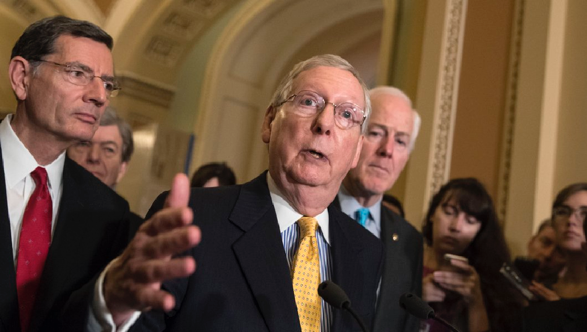
Last week, Senate Majority Leader Mitch McConnell announced that if Republicans are unable to pass to their version of Obamacare repeal – the Better Care Reconciliation Act (BCRA) – “then some kind of action” to stabilize “the private health insurance market must occur.” McConnell’s remarks underscore a larger truth that has often been lost in the larger health care debate: with skyrocketing premiums, 86 insurers leaving the exchanges from last year, and 45 counties that are expected to have no insurer to choose from, Republicans are not in a political position to simply move past the issue.
If passage of the BCRA fails, here are the options McConnell and Senate Republicans have to fix Obamacare and keep it from collapsing:
- Providing Certainty On Cost-Sharing Subsidies: House Republicans and the Trump Administration have repeatedly delayed a lawsuit regarding whether or not the President has the authority to allocate subsidies to insurers to help coverlow-income enrollees’ deductibles. The uncertainty over this program has made it more difficult for insurers to plan for the next year. McConnell could pass legislation settling this dispute by making specific allocations of these cost-sharing subsidies. This move should have support from Democrats, including Senate Minority Leader Chuck Schumer.
- Re-Establishing The Reinsurance Program: Obamacare created reinsurance programs that paid out funds to insurers who attracted the sickest customers, therefore mitigating the risk for insurers and incentivizing them to join the market. Yet these programs have now expired. The BCRA currently allocates $50 billion over four years for reinsurance and McConnell could opt to pass a more limited bill funding this program.
- Suspend Or Eliminate The Health Insurer Fee: Obamacare imposes a nearly $14 billion tax on health insurers, which drives up premiums. The tax was suspended for 2017, but it is set to return next year. This could be passed as separate legislation or could be included in a larger spending or tax package.
- Out-Of-State Health Insurance: An idea that has been floated by Sen. Lamar Alexander (R-Tenn.) would allow Americans in counties without a health insurer to purchase insurance in any other state-approved exchange. The proposal would further the Republicans’ long-standing goal of allowing the purchase of health insurance across state lines, while helping to address an issue that is hurting Western and rural America in particular. However, with so many narrow networkswithin exchange-offered plans, such insurance may offer little actual coverage and care.
The Senate is expected to vote on a revised version of BCRA next week, and its failure is far from a forgone conclusion. However, McConnell’s comments do make clear that he is slowly moving the goal posts in the hopes that Republicans can come out of this health care debate without too much political damage done.
Subscribe to Receive Insights
"*" indicates required fields
News You Can Use
NEWSPAPERS VS. DIGITAL: ANTI-TRUST EDITION
The print news industry has long been struggling to stay alive in today’s digital-centric marketplace. While still trying to integrate high tech into their operations, newspapers are now using a new tactic in their fight for survival: lobbying Congress to exempt them from anti-trust laws so they can band together to take on Google and Facebook.
The News Media Alliance (NMA), a trade association that represents over 2,000 papers in the U.S., argues that the duopolistic dominance of Google and Facebook in the online advertising space has placed the social media giants at an unfair advantage in negotiations with individual media outlets. This legislative push is the first major effort from media industry leaders to limit the market influence of large digital companies. However, it may raise questions about the implications of this industry seeking favors from the very people they are tasked with holding it accountable.
Related Posts:

POLITICIZING PHILANTHROPY
The Ford Foundation recently announced it was committing $1 billion over ten years to “mission-related investing,” a growing trend in philanthropy that prioritizes investments into projects and companies with a broad social impact instead of seeking the largest possible financial return.
This approach enables foundations with sizable endowments to use their status as shareholders to pressure corporations, mutual funds, hedge funds, and other vehicles utilized by institutional investors to focus on promoting the foundation’s pet causes or social agenda, rather than generating shareholder value. Ultimately, investing should be about creating value and economic growth, but “mission-related investing” risks undermining the best interests of other shareholders and the company in the service of large foundations’ view of what’s best for the common good.
LUNCH ON THE IRS?
On their 2009 and 2010 tax returns, the National Hockey League’s Boston Bruins fully deducted the cost of providing meals to their players and coaches during trips to other cities for away games. The IRS decided the Bruins could only deduct 50% of the meal costs because they were provided away from the premises of the business, so the Bruins took the IRS to court. Last week, a U.S. Tax Court ruled against the IRS, siding with the hockey team and potentially opening the door for employers to fully deduct some meals provided to employees at business meetings away from company headquarters.
The IRS determined the meals could be fully deductible because they were provided in a space that was leased by the team as a place to operate their business, and took place during the workday. However, it remains unclear if this ruling will apply to meetings at restaurants and other types of corporate meetings where these conditions may not be the same. The implications of the decision are even more uncertain because the IRS has not updated its regulations on meal deductions since 1978, even though Congress has changed the law several times. The case shows yet again how the hyper-complicated and arbitrary nature of the tax code can make planning difficult for businesses, and fail to account for legitimate costs of doing business.
VOLVO’S ELECTRIC MARKETING GAME
Volvo’s announcement that all of its cars will be hybrids or gas-electric hybrids by 2019 was championed by major media outlets as signaling the “death knell of the internal combustion engine.” While the media hype surrounding the new approach allows Volvo to bolster its image as cutting-edge among their affluent customer base, the reality is that the auto manufacturer, which is owned by a Chinese electric car manufacturer, will continue to employ the internal combustion engine, while adding a plugin-hybrid option in each vehicle as a complement.
While higher-end brands like Volvo can make these changes with only relatively small increases in price, many mainstream automakers are unable to do so without rendering their products unaffordable. This dynamic demonstrates how the electric car market remains more of a status symbol for the wealthy than a realistic alternative to the internal combustion engine.
THE NANNY STATE ATTACK ON SCREEN TIME
A new ballot initiative in Colorado proposes to criminalize the sale of all handheld wireless technology – including smartphones – to individuals aged 13 and younger. Proponents argue the measure is necessary to limit child inactivity. However, the proposal may actually have the opposite effect, with opponents pointing out that such devices can promote child independence by providing them a way to contact their parents and call for help when away from home.
In addition, banning smartphones, tablets, and other devices would prevent children from using them for academic purposes, such as research and connecting with tutors. Even worse, the proposal would turn parents, who seek to realize these benefits, into criminals overnight. This measure is another example of how attempts to legislate solutions to perceived societal ills can create more problems than it solves.