Betting on Washington
Here’s What You Need To Know…
More than $7 billion traded on Kalshi’s World Cup markets in June before the group stage was even over. Now the NFL season is weeks away, nearly $200 million has already traded on markets tied to this year’s midterms, and almost $700 million is riding on who wins the presidency in 2028.
Prediction markets are no longer the novelty many Americans discovered during the 2024 presidential election. They have become a mass-market business.
That may be exactly when their political problems begin.
Subscribe to Receive Insights
"*" indicates required fields
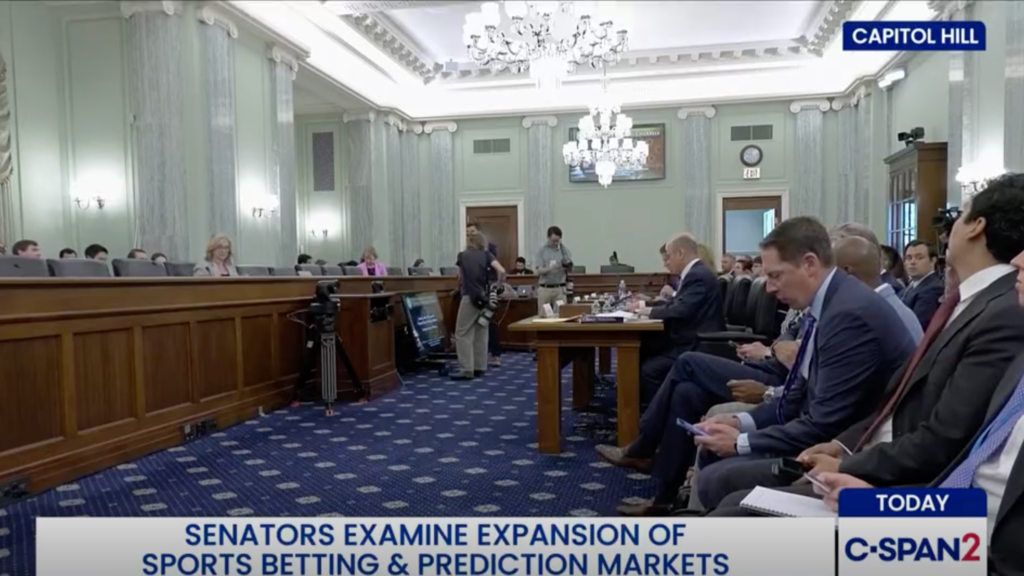
CFTC Chairman Michael Selig calls prediction markets “truth machines” and argues they are federally regulated financial markets. Utah Gov. Spencer Cox has warned they amount to “putting a casino in the pocket of every single American.” Senate Commerce Chairman Ted Cruz (R-TX) is openly asking whether the platforms are “defying the law” and infringing on state sovereignty.
It might seem like a niche industry issue, but it’s increasingly taking center stage in political and policy debates.
Republican and Democratic state officials are fighting the industry in court. Congress is investigating potential insider trading. Tribes are warning about threats to their gaming rights. The casino industry wants states back in charge. Even major sports leagues are pressing for tougher restrictions on the contracts prediction markets can offer.
Related Posts:


For now, Chairman Selig is perhaps the friendliest federal regulator the industry could ask for. But behind that federal green light is a much less settled question: Are prediction markets actually financial markets, or did a novel reading of commodities law create a way to offer nationwide gambling without calling it gambling?
Prediction markets aren’t the first disruptive industry to get buffeted by the wins of political skepticism, and they won’t be the last. But with football season gearing up and the midterms about to put this debate in front of millions of Americans, the industry is about to learn how hard it can be to predict political fallout if you don’t take time to understand what’s driving it. Here’s what public affairs professionals need to know as the political uproar unfolds.
One Man’s Financial Instrument Is Another Man’s Bet
The basic product is simple. Traders buy contracts based on whether something will happen, and a contract trading at 40 cents pays $1 if the event happens and nothing if it does not.
The legal argument is more complicated.
Kalshi operates as a federally regulated Designated Contract Market under the Commodity Futures Trading Commission. Rather than a sportsbook taking the other side of a wager, its customers trade contracts with each other through an exchange.
That distinction is doing a lot of work.
Selig argues event contracts are “swaps” covered by federal commodities law and that states are engaged in a “power grab” when they attempt to regulate them as gambling.
To critics, the distinction can look almost semantic. Rep. Dusty Johnson (R-SD) captured the problem at a House hearing last month: “To many Americans, these products look an awful lot like sports betting.”
Put money on whether interest rates rise and it sounds like a financial product. Put money on whether the Eagles beat the Cowboys and most Americans already have a word for that.
The disconnect between the legal argument and how the product is perceived is where much of the industry’s political risk begins.
The Industry’s Washington Wager
While the Biden-era CFTC tried to restrict political event contracts, Trump’s CFTC reversed course, withdrew the old proposal, began defending prediction markets against state regulators, and proposed a new framework this summer designed to let many event markets proceed while scrutinizing contracts involving areas like war, assassination, terrorism and certain sports-related events.
The agency has gone far beyond issuing guidance. It has sued states including Arizona, Connecticut, Illinois, and New York to defend what it calls its “exclusive jurisdiction” over these markets.
Adding to the complexity: Selig is currently the only sitting commissioner on a commission normally composed of five members.
And the Trump appointee has to contend with unusually close political relationships: Donald Trump Jr. advises both Kalshi and Polymarket and invested in Polymarket through his venture firm, while Trump Media spent much of the past year developing its own prediction-market offering before scrapping the plan this month.
All of that gives the industry powerful allies today. It also makes the current regulatory settlement easier for critics to portray as politically contingent.
And outside Washington, states are testing just how far the CFTC’s protection extends.
Nearly 40 states and the District of Columbia have joined litigation supporting state authority to regulate prediction markets. Minnesota enacted the country’s first statewide statutory ban before a federal judge temporarily blocked it. Courts in Massachusetts and elsewhere have allowed state restrictions to proceed, while the Third Circuit has sided with Kalshi’s federal-preemption argument. Just last week, a federal judge ruled Utah could enforce its anti-gambling laws against prediction markets.
This is not a clean partisan fight. Republican Utah and Democratic Minnesota may disagree about almost everything else, but both see a federal regulator stepping into territory states have traditionally controlled.
The Category Is Becoming The Target
That creates another challenge for the companies themselves.
Kalshi has made a concerted effort to be the regulated good neighbor. It built its business within the CFTC framework, has fined and suspended congressional candidates for betting on their own races, and says it has blocked dozens of campaign staffers attempting to trade on their candidates.
Polymarket took a very different route. Its crypto-based international platform grew largely outside the U.S. regulatory system after a 2022 CFTC settlement pushed it offshore, while a separate regulated U.S. entity is now being developed.
But political scrutiny does not necessarily respect those distinctions.
The Army service member accused of using classified information about a secret U.S. operation to make more than $400,000 traded on Polymarket. Candidates betting on themselves became a Kalshi story. And when House Oversight Chairman James Comer launched an insider-trading investigation in May, he demanded information from both companies, warning the pattern suggested “Congressional action may be necessary.”
Political scrutiny rarely makes a distinction between industry actors when they’re making an argument against an entire category. Particularly when there are competing interests and stakeholders hoping to stop that industry’s traction. American Gaming Association CEO Bill Miller calls the platforms “backdoor betting operations” and says the CFTC is attempting to redefine sports betting to put it beyond state and tribal control.
Tribal governments have made prediction markets a sovereignty issue. Senators Lisa Murkowski (R-AK) and Brian Schatz (D-HI) recently pressed the CFTC for formal tribal consultation, and the Senate Indian Affairs Committee convened tribal leaders, Ohio’s solicitor general, and a gambling-policy expert for an August 4 roundtable devoted entirely to prediction markets.
The NFL is now pressing regulators to prohibit some easily manipulated sports contracts and raise the minimum trading age. Public-health advocates are mobilizing around addiction concerns, with Minnesota Attorney General Keith Ellison claiming the products are “designed to be addictive.”
Indeed, every expansion into a new type of event creates another potential opposing force. Just last week, senators from wildfire-prone states asked the CFTC to crack down on predicitions tied to wildfires, warning that wagers could create perverse incentives for arson.
The more things Americans can bet — or “trade” — on, the more political fights the industry can inherit.
The Odds Are About To Get Interesting
There’s clearly demand for prediction markets. The harder question is whether explosive consumer adoption can become durable political legitimacy.
The NFL season will dramatically increase the visibility of sports contracts just as states, tribes, gambling regulators and leagues are questioning the rules governing them. Then the midterms will put political markets front and center while campaigns, elected officials and government employees possess exactly the kind of information that can move those markets.
For prediction-market companies, federal regulatory compliance alone may not be enough. They need to understand which contracts are creating political exposure, how opposition is organizing across states and stakeholder groups, where seemingly isolated controversies are reinforcing a broader narrative, and whether policymakers actually distinguish between responsible operators and the category as a whole.
Kalshi can be the best-regulated company in the industry and still inherit a Polymarket scandal. A favorable CFTC can win one preemption case while another state establishes a roadmap for fighting back. One controversial market can give an entirely new group of policymakers a reason to care. A shift in Congressional control or a change in The White House after the 2028 election could bring about a very different regulatory environment
Prediction markets have proven Americans will trade on almost anything. The industry’s biggest wager may be that Washington will keep letting them.
If you or your team need help navigating this shift, Delve Research is here to help you see further, act faster, and navigate a volatile landscape smarter.