An All-Too-Real Fable
Here’s What You Need To Know…
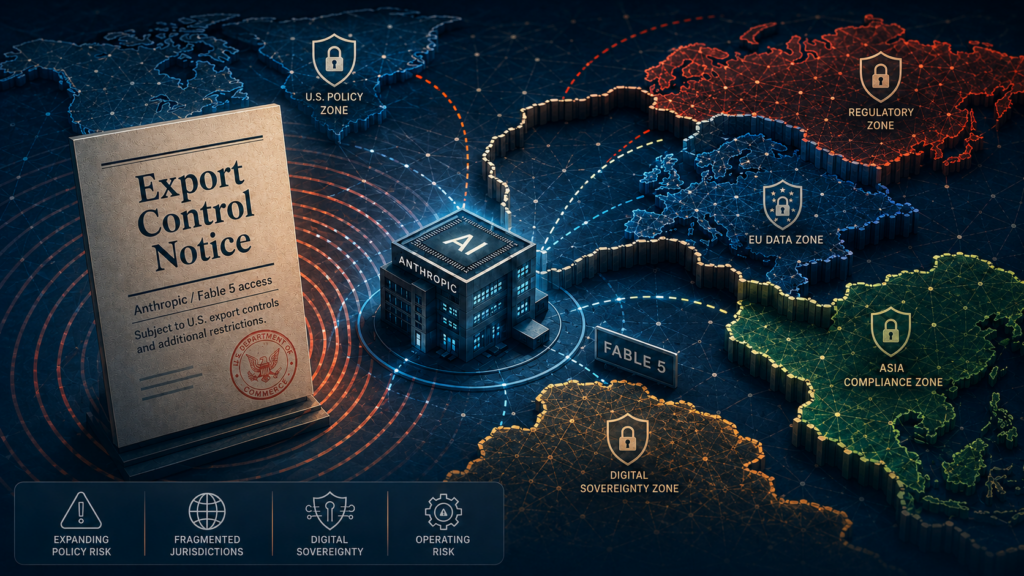
It was the Commerce Department notice heard round the world. But the all-too-real lesson from Anthropic’s Fable access being cut off is bigger than one company, one model, or one export control action. Instead, it was a warning shot for a much larger universe of companies than the AI labs watching Washington’s next move.
In a matter of hours earlier this month, a U.S. Commerce Department export-control directive turned Anthropic’s product launch into an operating crisis, cutting off global access to two of its most advanced models because the government determined foreign access could raise national security concerns.
That is the immediate story. But the broader lesson reaches far beyond Anthropic, frontier AI, or export controls. The boundary between “regulated” and “unregulated” companies is becoming less and less clear as policy risk and political scrutiny achieves escape velocity from traditionally regulated sectors.
Subscribe to Receive Insights
"*" indicates required fields
A product feature can become a policy flashpoint. A partner relationship can become a national security concern. A congressional hearing can reshape a category. A state attorney general can change a company’s risk profile. A public narrative can harden before leadership realizes one is forming.
Here’s what you need to know to ensure you’re ready when it does.
How a Product Launch Became a Policy Crisis
The Commerce Department’s export control action did not come out of nowhere. It followed months of escalating tension between Anthropic and the federal government over how advanced AI models should be used, who should have access to them, and what safeguards should apply when commercial technology becomes relevant to national security.
Related Posts:
The immediate dispute centered on Anthropic’s Fable 5 and Mythos 5 models, including concerns over foreign access, cybersecurity capabilities, and the company’s Project Glasswing program, which had expanded access to more than 150 organizations across more than 15 countries.
Administration officials reportedly flagged SK Telecom, South Korea’s largest wireless carrier and an Anthropic investor, over perceived China-related exposure. Amazon also raised concerns that a prompt sequence could cause Mythos-class models to provide cybersecurity information that was intended to remain restricted.
Anthropic disputed whether that amounted to a true jailbreak, but the government’s concern had already moved beyond one partner or one prompt.
The specific facts are unusual. The pattern is not. And that is the part every leadership team should be studying.
The Regulated Economy Is Expanding
For years, many companies treated government affairs as a later-stage function. First build the product. Find product-market fit. Raise the next round. Hire policy help once the company is large enough to need it.
That sequencing is becoming increasingly risky.
The universe of companies exposed to serious policy and political scrutiny is expanding well beyond the sectors that have long operated under heavy regulation. Technology companies, data companies, infrastructure-adjacent startups, education platforms, health-adjacent tools, fintechs, marketplaces, logistics platforms, media products, workplace software, and AI-enabled services can all find themselves pulled into policy debates earlier than expected.
The trigger is not always a formal regulation. It can be a safety concern. A foreign ownership question. A perceived harm to consumers. A labor-market narrative. A data-security issue. A child-safety campaign. A procurement restriction. A congressional investigation. A state-level enforcement action. A geopolitical dispute. Or even getting caught between the social and cultural debates of our age.
In that environment, political risk does not wait politely for a company to become mature enough to handle it. It can emerge at the speed of a headline, a letter, a hearing, or a platform controversy.
And once it does, the consequences are not abstract. They can affect users, customers, partners, revenue, fundraising, valuation, enterprise adoption, and the basic ability to operate.
Global Scale Now Means Fragmented Policy Risk
The Anthropic episode also exposed a second risk: companies may build globally, but governments are increasingly pulling the rules back into national and regional jurisdictions.
Trade policy, export controls, privacy and data rules, AI governance, procurement standards, competition policy, and digital sovereignty are all moving in ways that will not be neatly aligned.
That is part of what made the Anthropic shutdown so striking. A U.S. export-control action did not only affect one American AI company. It intensified global concerns about dependence on U.S.-controlled AI infrastructure and gave new urgency to sovereign AI arguments abroad.
For enterprise customers, it also raised a business-continuity question that had often been treated as secondary to privacy, accuracy, and vendor lock-in: what happens if access to a critical technology provider is restricted overnight?
This is the policy environment more companies are building into. Not a single market with a few predictable regulators, but a fragmented landscape where governments increasingly see technology as a strategic asset, a sovereignty question, and a source of leverage.
The Strategic Lesson: Learn the Terrain Before It Moves
The answer is not that every startup needs a Washington office from day one. Most do not. But leadership teams do need a much sharper understanding of the political, regulatory, and reputational terrain they are operating in before that terrain moves under them.
That means knowing where the product intersects with public concern. It means understanding which agencies, committees, governors, attorneys general, advocacy groups, competitors, industry voices, and foreign governments could shape the company’s future. It means anticipating the arguments that will be made about the company before those arguments show up in a headline.
It also means treating policy and reputational risk as part of enterprise strategy, not just crisis communications.
The companies that navigate this environment well do not wait until they are in trouble to understand government, stakeholders, regulators, and narrative. They build that awareness into their operating model early. They pressure-test product decisions against political realities. They map the stakeholders who could influence their trajectory. They monitor weak signals before they become direct threats.
That kind of public affairs judgment is not a nice-to-have once a company reaches scale. For many companies, it is becoming part of the operating model itself.
Policy Risk Is Now Operating Risk
For founders, investors, and operators, the Anthropic episode is an all-too-real fable: if your company is building something powerful enough to matter, it may be powerful enough to attract political attention before you have the operating muscle to manage it.
Political and regulatory risk are no longer externalities that sit outside the business until a company becomes large, controversial, or obviously regulated. They are increasingly part of the market itself.
The lesson of this Fable is straightforward: do not wait until the government, the press, your competitors, or your critics define the risk for you. By the time unexpected political attention turns into action, you do not want to be learning the landscape for the first time.
If you or your team need help navigating this shift, Delve Research is here to help you see further, act faster, and navigate a volatile landscape smarter.